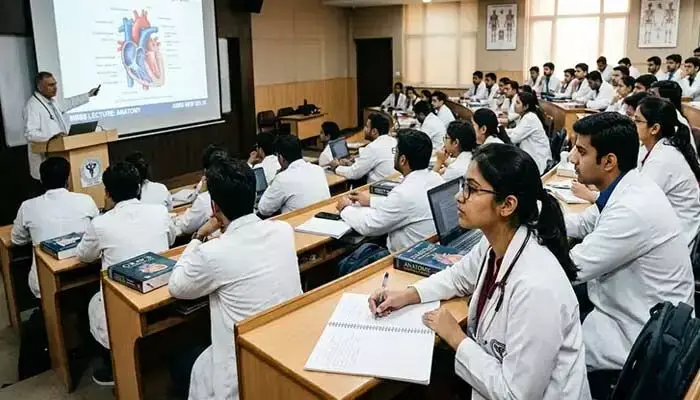
A major debate has emerged in Andhra Pradesh over the future of government medical education. Critics argue that instead of strengthening the public healthcare system, the government is moving towards privatization through the Public-Private Partnership (PPP) model.
The controversy intensified after the National Medical Commission (NMC) released the MBBS seat matrix for the 2026–27 academic year, revealing that Andhra Pradesh lags behind several other states in terms of government medical colleges and government MBBS seats despite having a large population.
Why Is Andhra Pradesh Lagging Behind in the NMC Seat Matrix?
The NMC’s 2026–27 seat matrix has raised several concerns regarding the state’s public medical education infrastructure.
- Andhra Pradesh, with a population of nearly 53 million, has only 19 government medical colleges.
- Telangana, despite having a smaller population, has 36 government medical colleges.
- Himachal Pradesh, with a population of just 7.5 million, has six government medical colleges.
The comparatively lower number of government medical colleges in Andhra Pradesh has triggered criticism over the state’s healthcare planning.
Government MBBS Seats Per 10 Lakh Population
According to the NMC seat matrix, the availability of government MBBS seats per one million population is as follows:
| State | Government Medical Colleges | Government MBBS Seats | Seats Per 10 Lakh Population |
|---|---|---|---|
| Telangana | 36 | 4,400 | 116 |
| Jammu & Kashmir | 10 | 1,525 | 112 |
| Himachal Pradesh | 6 | — | 96 |
| Andhra Pradesh | 19 | 3,515 | 66 |
These figures indicate that Andhra Pradesh offers significantly fewer government MBBS seats per capita compared to several other states, particularly Telangana.
What Happened to the 17 Government Medical Colleges Started Under the YSRCP Government?
During the tenure of the YSR Congress Party (YSRCP) government, 17 new government medical colleges were launched across Andhra Pradesh as part of an ambitious expansion of public healthcare.
The key objectives of the project included:
- Increasing government MBBS seats for economically weaker students.
- Improving healthcare access in every district.
- Upgrading government hospitals into super-specialty institutions.
- Expanding medical education into rural and underserved regions.
Of these, seven colleges have been completed, while the remaining institutions are still under various stages of construction.
Are Government Medical Colleges Being Handed Over to Private Players Under the PPP Model?
One of the most controversial decisions taken by the present government is the proposal to operate 10 government medical colleges under the Public-Private Partnership (PPP) model.
The move has drawn sharp criticism from opposition parties and healthcare activists.
Critics allege that:
- Government-funded medical colleges are being transferred to private entities.
- Valuable government land is being leased to private institutions at concessional rates.
- Private control over public healthcare infrastructure may gradually increase.
- Affordable government healthcare services could become more expensive in the future.
Students Allegedly Losing Government MBBS Seats
The opposition claims that the PPP policy has resulted in a reduction in government MBBS seats available to students.
According to the allegations:
- 700 government MBBS seats were lost in 2024–25.
- 1,750 seats were reduced in 2025–26.
- A total of 2,450 government seats have reportedly been lost over two academic years.
Critics argue that this could severely affect students from poor and middle-class families who aspire to pursue medical education.
Only One New Government Medical College Approved for Andhra Pradesh
For the 2026–27 academic year, the National Medical Commission approved seven new government medical colleges across India.
Among them:
- Four colleges were sanctioned to Chhattisgarh.
- The remaining approvals went to other states.
For Andhra Pradesh, the only approval this year was for the Piduguralla Government Medical College, a project initiated during the previous YSRCP government.
Opposition leaders argue that this reflects the slow pace of expansion of government medical education in the state.
Telangana Moves Ahead While Andhra Pradesh Falls Behind?
The comparison between the two Telugu states has once again become a political talking point.
Telangana:
- 36 government medical colleges
- More than 4,400 government MBBS seats
- 116 government seats per 10 lakh population
Andhra Pradesh:
- Only 19 government medical colleges
- 3,515 government MBBS seats
- Just 66 government seats per 10 lakh population
These figures have intensified criticism that Andhra Pradesh is falling behind in public medical education.
Should Public Healthcare Be Strengthened or Privatized?
Medical education is widely regarded as a public service rather than a commercial enterprise.
Supporters of expanding government medical colleges argue that:
- More poor students can pursue MBBS education.
- Government hospitals will have better availability of specialist doctors.
- Affordable healthcare services can be provided to the public.
- Rural healthcare infrastructure can be significantly improved.
Critics question whether prioritizing the PPP model over strengthening government institutions is the right policy direction.
Is This the Vision for Public Healthcare?
The larger debate now centers on whether government medical colleges, built with public funds, should remain fully under government control or gradually shift into private management through PPP arrangements.
Following the release of the NMC 2026–27 MBBS seat matrix, concerns have grown over Andhra Pradesh’s position in public medical education compared to several other states.
Critics say the government should present a clear roadmap for expanding government medical colleges, increasing government MBBS seats, and ensuring affordable, accessible healthcare for all citizens.