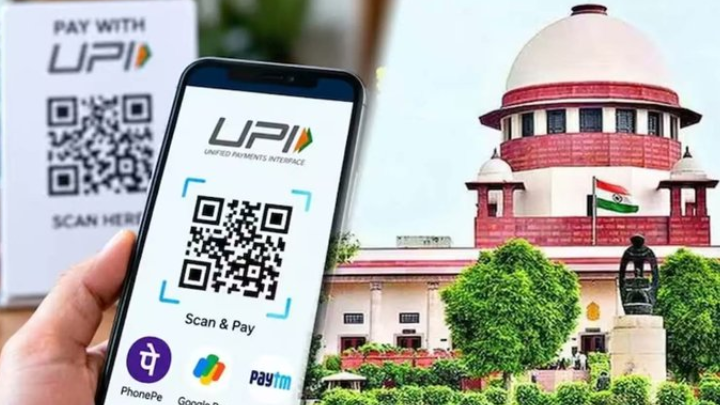
The Supreme Court has sought answers from the Centre, the Reserve Bank of India (RBI) and the National Payments Corporation of India (NPCI) on the legal and policy basis for imposing Merchant Discount Rate (MDR) charges on certain UPI transactions above Rs 2,000.
The court, while hearing a Public Interest Litigation (PIL) challenging the new UPI fee framework, asked who would benefit from the charges and how the money collected would be distributed among the participants in the digital payments ecosystem.
Supreme Court Refuses to Stay UPI MDR
The petitioner sought an immediate stay on the implementation of the new UPI charges. However, the Supreme Court declined to grant an interim stay.
The court has asked the Centre, RBI and NPCI to file their responses explaining the legal basis, purpose and distribution mechanism of the proposed MDR. The matter will be considered further after the affidavits are filed. The Supreme Court has not yet given a final ruling on the legality of the UPI charges.
0.4% MDR on UPI Payments Above Rs 2,000
Under the new framework, a 0.4% Merchant Discount Rate will apply from October 15, 2026, to specified Person-to-Merchant (P2M) UPI transactions above Rs 2,000.
Transactions of up to Rs 2,000 will not attract MDR. Person-to-Person (P2P) UPI payments will also remain outside the new charge structure. Small merchants meeting the specified eligibility conditions are also exempt from the MDR.
For transactions of Rs 75,000 or more, the MDR will be capped at Rs 300.
Rs 5 Charge for Selected Sectors
A flat MDR of Rs 5 will apply to eligible UPI transactions above Rs 2,000 in certain essential and thin-margin sectors.
These include:
- Railways
- Telecommunications
- Insurance
- Fuel
- Agricultural inputs
The framework also provides for a separate MDR structure for certain capital-market transactions.
PIL Challenges UPI MDR Framework
The PIL was filed by advocate Anjan Datta. It challenges the Centre’s September 14 notification and the MDR framework announced on September 15.
The petition argues that the new fee structure was introduced without adequate statutory safeguards, transparency and public consultation. It also questions the legal basis for withdrawing the earlier zero-charge protection for certain UPI transactions above Rs 2,000.
The petitioner has sought the cancellation or suspension of the new charges. Alternatively, the PIL asks the authorities to disclose relevant data and impact assessments and reconsider the framework while protecting small and micro businesses.
Who Will Get the UPI MDR Revenue?
One of the key issues raised by the Supreme Court is the distribution of the money collected through MDR.
The court has sought clarity on who will benefit from the charges and how the revenue will be shared among banks, payment service providers and other participants in the UPI ecosystem. The RBI has said the MDR framework is intended to support investment in payment infrastructure and the long-term sustainability of digital payments.
No Final Decision Yet on UPI Charges
The Supreme Court has not made a final determination on the legality of the new UPI MDR framework.
For now, the October 15 implementation schedule remains in place because the court has declined to grant an interim stay. The next stage of the case will depend on the affidavits and explanations submitted by the Centre, RBI and NPCI.
The case could therefore have wider implications for the future pricing and sustainability of India’s UPI payment ecosystem.