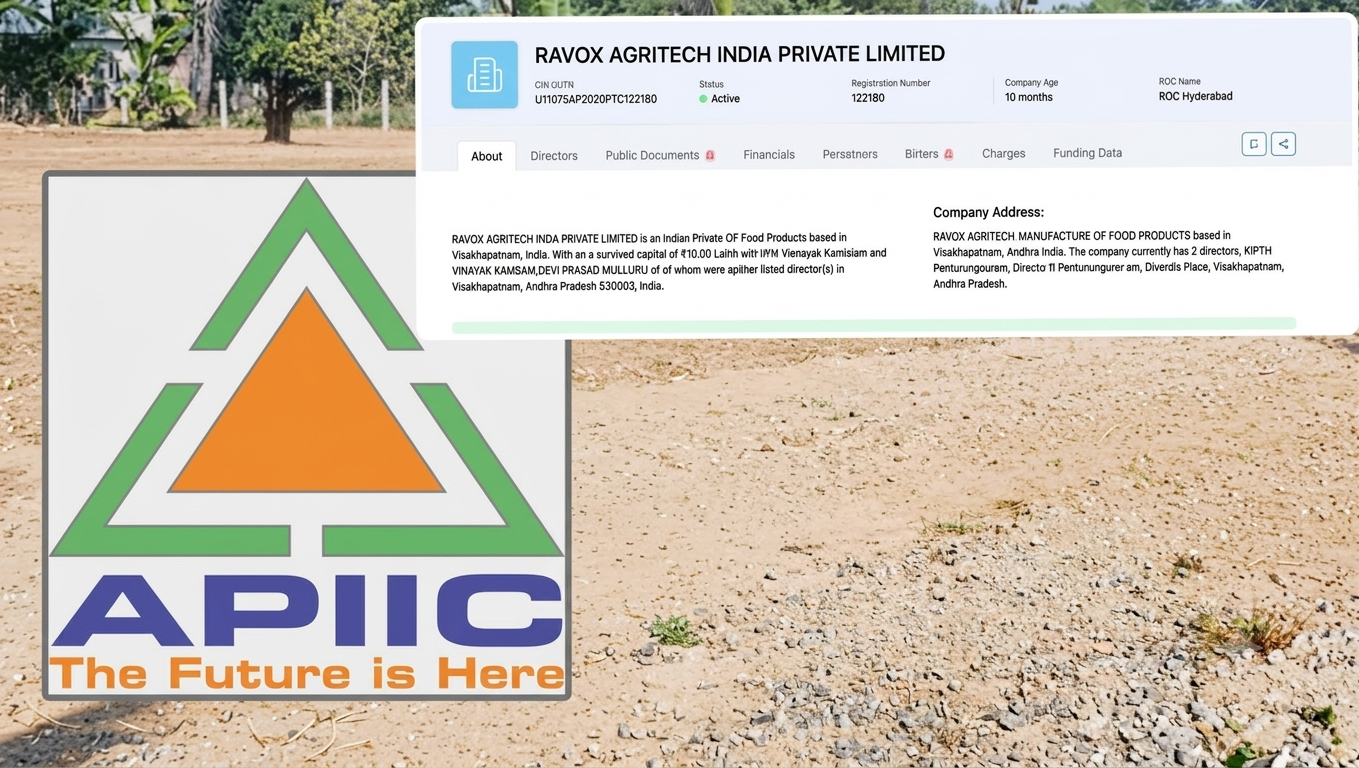
Andhra Pradesh’s policy of attracting investments through industrial land allotments and government incentives is facing renewed scrutiny following the allotment of land and incentives to Raoex Agritech India Private Limited.
According to GO 259 issued by the Industries Department, the company has been allotted 40.50 acres of land through APIIC at Kaigal Revenue Village in Baireddipalle Mandal of Chittoor district for an integrated food park.
Raoex Agritech Incorporated in November 2025
Raoex Agritech India Private Limited was registered on November 20, 2025, with a Visakhapatnam address, according to the details cited in the government order.
The company has an authorised capital of ₹10 lakh and paid-up capital of ₹9 lakh. Devi Prasad Mulluru and Keerthi Vinayak Kambam are listed as its directors.
The proposed integrated food park is expected to involve an investment of ₹1,388.14 crore and generate around 1,000 direct jobs.
₹592 Crore in Government Incentives
The project has been offered incentives with a total value of around ₹592.22 crore, according to the details cited in the government order.
The incentives reportedly include:
- ₹272.64 crore — Capital subsidy
- ₹280.83 crore — Net SGST reimbursement
- ₹18.60 crore — Electricity charges concession
- ₹18.60 crore — Electricity duty exemption
- ₹1 crore — Interest subsidy
- ₹0.55 crore — Stamp duty exemption
The scale of the proposed investment and incentives has raised questions about the project’s financing structure and implementation capacity.
Questions Over Funding Capacity
One of the key questions being raised is how a company with a reported paid-up capital of ₹9 lakh will mobilise funds for a project estimated to cost ₹1,388.14 crore.
The issue does not necessarily mean that the company must finance the entire project through its paid-up capital. Large industrial projects can involve debt, equity from investors, project finance and other funding arrangements.
However, questions remain over what financial-capacity checks were carried out before the land and incentives were approved. These include whether the government examined the company’s proposed sources of investment, bank financing arrangements, guarantees, investor commitments and ability to implement the project.
Wider Concerns Over New Industrial Companies
The Raoex Agritech allotment comes amid wider discussions over land and incentives being provided to newly established companies in Andhra Pradesh.
Companies such as Ursa Clusters, IndiChip Semiconductors, Gridon Energy, NAN Greenmet, Sky Storage Solutions and Zinfra Precisions have also been cited in discussions surrounding industrial land allotments, proposed investments and government incentives.
The central issue is not simply the age of a company. Rather, questions have been raised about how the government evaluates the financial strength, investment capacity, industry experience and project execution capability of companies seeking large public incentives.
Need for Transparency in Industrial Incentives
The Andhra Pradesh government has been promoting faster investment approvals under its broader industrial-development strategy. Such policies can provide incentives to companies to establish manufacturing facilities, create employment and develop local industrial ecosystems.
At the same time, the allocation of public land and large tax or capital incentives raises questions about transparency, eligibility criteria and safeguards if a project is delayed or not implemented.
The Comptroller and Auditor General has previously examined issues relating to government land allotments in Andhra Pradesh, including whether allotment processes were transparent, uniformly applied and in the public interest.
Demand for Greater Disclosure
Against this backdrop, there are calls for the government to publish detailed information on major industrial land allotments and incentives, including the criteria used to assess companies before approval.
Such disclosures could include the source of project funding, bank guarantees, investor commitments, implementation timelines, employment targets, land-use conditions and milestone-based release of incentives.
For projects involving substantial public resources, transparency over these parameters would allow citizens to assess whether promised investments and employment targets are being translated into actual industrial activity.
The Raoex Agritech project therefore brings the broader question of how Andhra Pradesh evaluates newly incorporated companies before providing them with large land parcels and financial incentives into sharper focus.