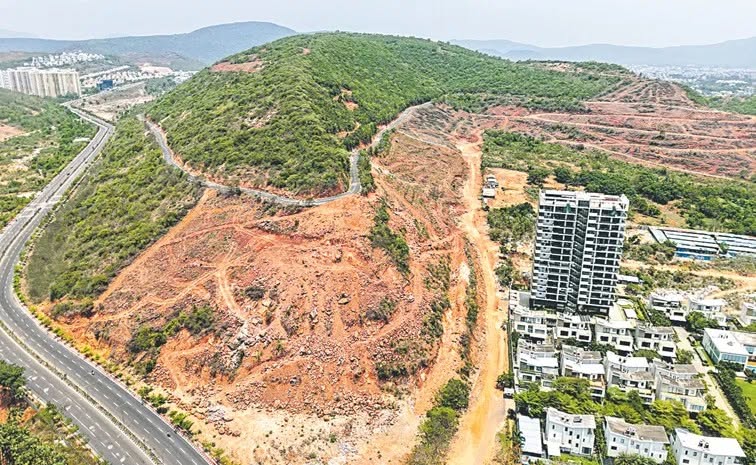
Visakhapatnam is a city defined by its blue sea on one side and lush green hills on the other. These hills serve as a natural protective shield for the city and play an important role in maintaining its ecological balance. A ‘Sakshi’ ground report alleging large-scale excavation across several hill areas in Visakhapatnam has now triggered debate among political and environmental circles.
The report alleged that several green hill ranges in Visakhapatnam are being extensively excavated during the tenure of the Chandrababu government, causing them to lose their natural landscape. According to the report, the damage stretches from Simhachalam to the IT Hills.
The report claimed that excavation activities are taking place across nearly ten major hills in and around Visakhapatnam, including Appanna Konda, Pavurala Konda, Pedda Konda, Tarluwada Konda, Ramakonda, Gangalamma Konda and Panchadarla Konda.
Concerns are now being raised over the possible impact of the disappearance of these hills on the city’s environment, water resources and historical heritage.
From Simhachalam to IT Hills: Green Hills Being Reduced to Bare Slopes?
The green hills surrounding Visakhapatnam are not merely scenic landmarks. Environmentalists say they play an important role in maintaining the city’s ecological balance and in reducing the impact of pollution from the port and industrial areas.
However, the report claimed that heavy machinery is currently being used to excavate several hill areas.
According to the report, extensive excavation on both sides of Oori Konda has already resulted in significant loss of greenery. It warned that if the activity continues, the hill itself could soon lose its natural shape and eventually disappear.
The report alleged that this is not an isolated case and that similar excavation activities are taking place across several hill areas within and around the city.
Questions Over Allocation of Valuable Land
The report also raised allegations regarding the allocation of valuable land in the name of companies at comparatively low prices.
According to the report, 30 acres of land were allocated to a real estate company, Satva, for setting up an IT company, and 50 per cent of that land was subsequently transferred to another real estate company, Orwell.
The report further stated that 15 acres at Pavurala Konda near Bheemili Beach were allotted to Myra Bay View Resorts.
The area reportedly contains Buddhist remains dating back to the third century BC. The report expressed concern that excavation activities could pose a threat to these archaeological remains.
Threat to Alluri Caves Due to Mining?
The report also raised concerns over the impact of mining on historical heritage in the Visakhapatnam–Anakapalli region.
According to the report, extensive mining is being carried out in the Gangalamma Konda area under Sarugudu panchayat in Nattavaram mandal of Anakapalli district.
It alleged that the mining activity could threaten historical caves associated with freedom fighter Alluri Sitarama Raju.
The report claimed that mining is taking place across 130.5 hectares in an area where the 1/70 Act is applicable, in the names of tribal individuals.
It stated that 110 hectares were being mined in the name of Jartha Lakshmana Rao, while another 20.5 hectares in Survey No. 532 were also being excavated.
According to the report, around 1.8 million tonnes of mineral ore have already been transported, while plans are reportedly in place to transport another 2 million tonnes.
The report further stated that an application had been submitted for mining across another 36 hectares in the name of Singam Bhavani.
If approved, the report claimed, the mining could pose a threat to seven caves in Gangalamma Konda near Asagiri village, an area associated with the planning of Alluri Sitarama Raju’s Manyam Rebellion.
Allegations of Excavation Up to 100 Feet Instead of 60 Feet
The report also alleged that excavation in the region was being carried out beyond the permitted depth.
According to the report, mining was allegedly being conducted to a depth of around 100 feet instead of the permitted 60 feet.
It claimed that the Nagulakonda area was gradually shrinking because of the excavation and that nearly ten surrounding tribal villages were facing difficulties related to drinking water and firewood.
Aluminium Ore: Allegations of Diversion to Odisha?
One of the key issues raised in the report concerns the quality and transportation of aluminium-bearing mineral ore.
The report alleged that higher-quality ore was being recorded as lower-grade laterite, thereby allegedly resulting in the payment of lower royalties.
At the same time, it claimed that ore containing a higher percentage of aluminium was being transported to plants in Odisha.
According to the report, approximately 20,000 tonnes of mineral were allegedly being transported every day, with the value estimated at around Rs 5,000 per tonne, amounting to nearly Rs 10 crore worth of mineral a day.
The report also alleged that the material was being transported through routes via Rautulapudi in Kakinada district, allegedly without the required forest clearances.
However, allegations concerning the distribution of proceeds and the alleged involvement of political leaders are matters that require independent verification. Official records and statements from the concerned authorities and companies would be necessary to establish the facts.
Three Mining Leases at Panchadarla Hills: Eventually Cancelled
The mining controversy surrounding the Panchadarla Hills was also discussed extensively in the report.
According to the report, three mining leases were granted without conducting a public hearing.
It claimed that two of the companies were linked to the son-in-law of Anakapalli MP CM Ramesh, while another company, Sri Lakshmi Narasimha Minerals, was reportedly recommended by another MP described in the report as being close to Jana Sena chief Pawan Kalyan.
The report stated that local residents and opposition YSRCP leaders had raised concerns that mining could threaten an ancient Shaiva temple and archaeological structures.
It also claimed that a water stream in Panchadarla had stopped flowing following the excavation activities.
According to the report, authorities subsequently cancelled the two leases linked to CM Ramesh’s son-in-law. The third lease covering five hectares in Survey No. 156/P was also reportedly cancelled recently following protests by YSRCP leaders.
Who Faced Action? Questions Over Accountability
The report raised another issue regarding the Panchadarla mining controversy.
It claimed that the government had not disclosed details in the cancellation notices regarding the extent of alleged illegal excavation, the value of the extracted material and the penalties imposed.
At the same time, the report stated that action had been taken against some lower-level officials and that the Assistant Director of Mines had been suspended.
However, it alleged that no action had been taken against the Rambilli Circle Inspector, who was accused of threatening villagers with cases for questioning the alleged illegal excavation, or against the RDO, who was alleged to have played a key role in the matter.
The report stated that following a series of stories published by ‘Sakshi’, the government issued orders declaring the Panchadarla Hills a no-mining zone.
Tarluwada Hills: What Happened to the Earlier Debate Over ‘Vishnupadas’?
The report also discussed the Tarluwada Hills from a political perspective.
It stated that reports had appeared in the past claiming that the hills contained Vishnupadas, or footprints associated with Lord Vishnu, and that the previous YSRCP government was allegedly planning to allocate the area to someone.
However, the report noted that the then government had clarified that there was no such proposal for allocation.
The report now alleged that more than half of the Tarluwada Hills have already been subjected to excavation, with the remaining portion also facing the possibility of disappearing.
It questioned why those who had previously raised concerns over the hills in the name of Vishnupadas were not speaking out about the alleged excavation activities taking place there now.
Excavation on Ramakonda: Threat to Historical Remains?
The report alleged that unauthorized excavation was taking place across five acres of Ramakonda in Survey No. 142, under the Rambilli revenue limits of Anakapalli district.
According to the report, local beliefs associate the hill with Lord Rama, while archaeological remains reportedly include a Rama Stupa and footprints attributed to Lord Rama.
The report claimed that the use of heavy machinery for gravel excavation was posing a threat to these historical remains.
It also alleged that gravel was being supplied to industries in the Achutapuram and Rambilli SEZ areas, with the material reportedly being sold for around Rs 12,000 per truckload.
Appanna Hills Also Under Pressure? Questions Over 160-Acre Land Allocation
The report stated that excavation activities were also affecting the Simhachalam Hills, one of the most important hill regions in Visakhapatnam.
According to the report, 160 acres of land belonging to the Simhachalam Devasthanam were allocated for a data centre.
The report noted that rainwater from the area had historically been channelled into the Mudasarlova Reservoir through natural and constructed drainage routes.
It expressed concern that ongoing excavation activities could obstruct these water-flow channels.
A reduction in the inflow of water into Mudasarlova Reservoir could potentially create water-related problems in surrounding areas, the report stated.
Concern Over 140 Acres of Forest and Hill Resources
Environmental activist Bolisetti Satyanarayana alleged that around 140 acres of forest and hill resources in Tarluwada were being damaged without the required environmental clearances.
He alleged that natural drainage channels and water sources were being filled with soil.
He also stated that carrying out such activities without environmental permissions could raise legal and regulatory questions.
‘Failure to Stop the Destruction Could Come at a Heavy Cost’
EAS Sarma, a former Central government secretary, expressed concern over excavation activities in the Simhachalam Hills near the Mudasarlova Reservoir.
He reportedly warned that mining activities could threaten the catchment area of the reservoir.
According to the ‘Sakshi’ report, Sarma called for criminal cases to be registered over the alleged mining activities and for environmental laws to be enforced.
He reportedly warned that continued excavation could expose the people of Visakhapatnam to serious consequences, including water shortages and natural disasters.
The Bigger Question: What Is the Future of the Hills in the Name of Development?
Visakhapatnam needs development. Industries need to come up. IT infrastructure, data centres and other facilities need to expand.
At the same time, however, questions are being raised over how much of the city’s natural hill landscape can be removed in the name of development.
How were permissions granted for excavation on a scale that could potentially alter natural water-flow channels? What measures were taken to protect historical sites? And what environmental safeguards are in place?
The controversy has brought renewed attention to questions surrounding mining permissions, environmental clearances, land allocations, mineral transportation and royalty payments.
The government may need to place complete details of these matters in the public domain to address the concerns being raised.
At the same time, allegations made in the report against political leaders, companies, officials and mining operators require verification through official records and appropriate investigations. Statements from the individuals and organisations facing allegations would also provide greater clarity on the matter.
What Happens to Visakhapatnam If Its Hills Disappear?
The alleged excavation activities involving the hills of Visakhapatnam are not merely a mining-related controversy. They are connected to several wider issues, including the environment, drinking water, forest resources, historical heritage, tribal livelihoods and the city’s long-term future.
From Simhachalam, Pavurala Konda, Tarluwada and Panchadarla to Ramakonda and Gangalamma Konda, and from the hills to the caves associated with Alluri Sitarama Raju, each issue raised in the report warrants careful examination.
Once natural hills are destroyed, rebuilding them is not realistically possible. Once natural water channels are blocked, restoring their original flow can be extremely difficult. And once historical remains are destroyed, they cannot simply be brought back.
The central questions, therefore, concern the permissions, interests and accountability behind the excavation activities reportedly being carried out in the name of Visakhapatnam’s development.
What safeguards will the government put in place to protect the city’s hills and natural resources?