
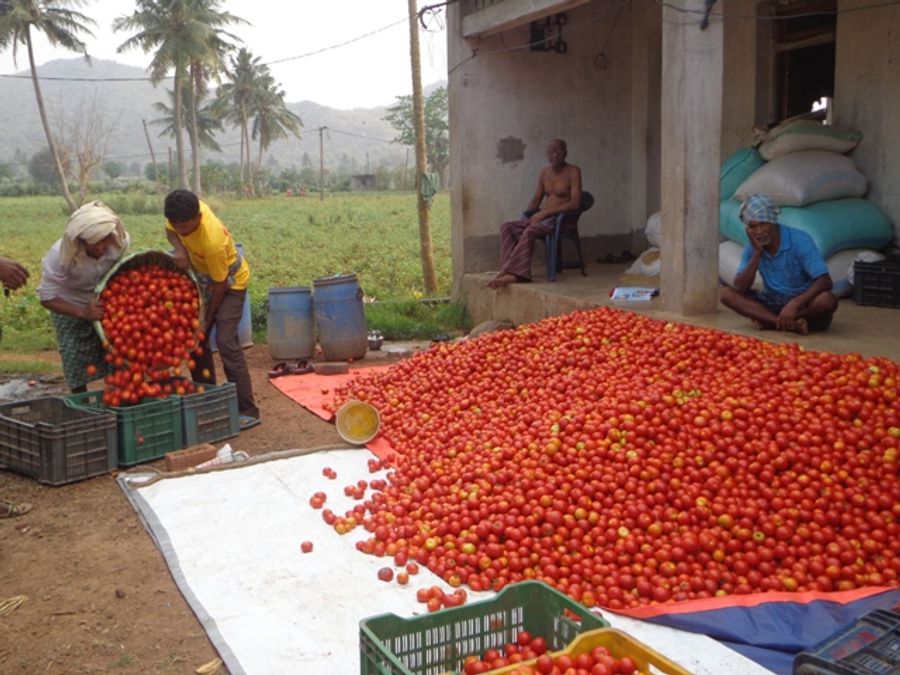
Tomato Prices Collapse, Leaving Farmers in Deep Distress
The condition of tomato farmers in the state is worsening with each passing day. Despite investing thousands of rupees in cultivation, farmers are receiving only ₹2 per kilogram after bringing their produce to the market. With prices crashing drastically, criticism is mounting that the government has failed to intervene to protect farmers.
The opposition alleges that instead of supporting farmers, the government is trying to evade responsibility by citing reasons such as poor quality produce and excess arrivals in the markets.
Madanapalle Market Sees Historic Price Crash
Tomato prices at Madanapalle, one of the largest tomato markets in the state, have fallen to unprecedented levels.
At present, farmers are getting only ₹2 to ₹3.20 per kilogram for tomatoes. However, the same tomatoes are being sold to consumers at ₹20 to ₹30 per kilogram in retail markets. This has exposed a huge gap between the price received by farmers and the amount paid by consumers.
With prices far below production costs, farmers say they are unable to recover even harvesting expenses, labour charges, and transportation costs.
Massive Arrivals Flood the Market
According to reports, Madanapalle market has witnessed a heavy influx of tomatoes in recent days.
Figures reported include:
- Around 12,215 metric tonnes of tomatoes arrived in a single day.
- Approximately 5,564 metric tonnes were First Grade tomatoes.
- Around 6,650 metric tonnes were Second Grade tomatoes.
- Reports also mention that nearly 1,180 tonnes arrived from various regions of the state.
Officials attribute the price crash to excess supply. However, farmers argue that market regulation during such situations is the government’s responsibility.
Opposition Recalls Support Measures During the YS Jagan Government
The opposition has questioned why tomato prices have fallen to ₹2 per kilogram now when similar crises were handled differently during the previous YS Jagan Mohan Reddy government.
According to the YSR Congress Party (YSRCP), the previous government intervened through the Marketing Department to protect farmers.
During that period:
- The government procured 8,460 tonnes of tomatoes.
- More than ₹18 crore was paid directly to farmers.
- The intervention reportedly helped prevent a complete collapse in market prices.
The opposition argues that similar market intervention is missing under the current administration.
Government’s Explanation for the Price Crash
Reports indicate that the government has cited two major reasons for the decline in tomato prices:
- The quality of tomatoes is below the expected standard.
- Excess arrivals in the markets have resulted in oversupply.
Farmers, however, strongly reject these explanations.
They argue that bumper harvests are a normal part of agriculture and that governments should have mechanisms in place to protect farmers whenever production exceeds demand.
Critics Say the Government Failed to Intervene
Farmer organizations and opposition leaders claim that despite the continuous fall in prices, the government has not taken direct steps to stabilize the market.
They argue that the government should have introduced measures such as:
- Price stabilization initiatives
- Government procurement centres
- Purchases through the Marketing Federation
- Supply of tomatoes to food processing units
- Emergency financial assistance for affected farmers
Instead, critics allege that the government has limited itself to explaining the reasons behind the price crash without implementing meaningful relief measures.
Are Farmers Being Denied Fair Value for Their Hard Work?
Cultivating one acre of tomatoes requires a substantial financial investment.
Farmers spend heavily on:
- Seeds
- Fertilizers
- Pesticides
- Labour
- Drip irrigation maintenance
- Transportation
Farmer groups say that when such investments yield only ₹2 per kilogram, the issue goes beyond falling prices and reflects a serious failure of the agricultural marketing system.
Who Will Compensate Farmers for Their Losses?
The steep decline in tomato prices has pushed thousands of farming families into severe financial distress.
Farmers and the opposition are demanding immediate government intervention to protect growers during periods of market collapse. Meanwhile, the government maintains that excess production and quality concerns are the primary reasons behind the current situation.
The larger challenge before the state government now is how to ensure remunerative prices for farmers while creating an effective system to stabilize agricultural markets during periods of oversupply.


