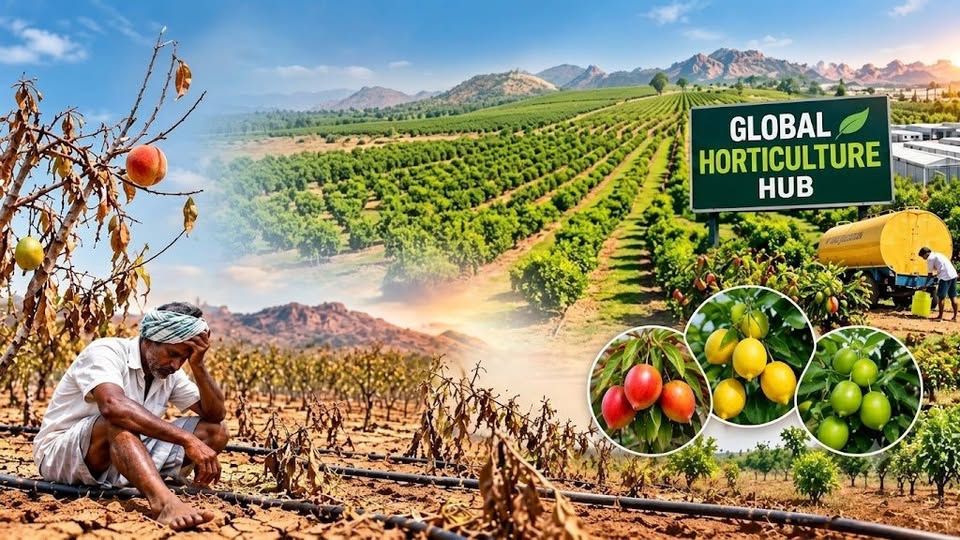
Rayalaseema: The Andhra Pradesh government has announced an ambitious plan to develop Rayalaseema as a global horticulture hub, with Madanapalle as a key centre. The proposed Rayalaseema Rising horticulture project aims to attract a total investment of around Rs 1 lakh crore.
The plan focuses on developing horticulture clusters, improving irrigation, building roads and cold-chain infrastructure, strengthening food processing and expanding export opportunities. However, questions are being raised over whether the region has adequate and reliable water resources to support such large-scale horticulture expansion.
Rs 1 Lakh Crore Plan, But When Will Farmers Get Water?
Under the proposed Global Horticulture Hub–Rayalaseema Rising initiative, the government plans to develop 201 horticulture clusters across 10 districts.
The project is proposed to be implemented in three phases between 2026 and 2029.
While the government has announced large investment targets, farmers in Rayalaseema continue to face concerns related to irrigation, crop prices and protection against crop losses.
For horticulture farmers, the immediate requirements remain clear: reliable irrigation, better market access, price support and protection against crop losses.
9 Lakh Acres of New Irrigation Potential
According to the government’s plan, around 9 lakh acres of new irrigation potential is targeted, while another 4.3 lakh acres of existing ayacut is proposed to be stabilised.
Water security is being presented as a key foundation for the proposed horticulture development.
However, this raises an important question: How quickly will irrigation facilities reach existing horticulture farms that are already facing water shortages?
For crops such as sweet lime, lemon and mango, reliable water availability is critical for maintaining orchards and improving productivity.
How Much Will the Government Actually Invest?
The Rs 1 lakh crore figure represents the combined investment target and does not mean that the entire amount will come directly from the state government budget.
According to official details, around Rs 40,352 crore is proposed as government investment, while approximately Rs 60,000 crore is expected to come from private investment.
The proposed government investment includes:
- Rs 20,884 crore for irrigation
- Around Rs 14,906 crore for horticulture development
- Rs 4,562 crore for rural roads
This makes the implementation schedule important. Farmers and other stakeholders are likely to closely watch when government funds are released, which projects receive priority and how quickly irrigation works are completed.
Horticulture Vision vs Ground-Level Farmer Challenges
The government wants to transform Rayalaseema into a major fruit production and horticulture hub, with greater focus on processing, exports, cold-chain facilities, marketing infrastructure and better connectivity.
The proposed infrastructure could support crops such as mango, lemon and sweet lime by improving storage, transportation and access to processing facilities.
However, the success of the Rayalaseema horticulture hub project will also depend on solving existing challenges faced by farmers.
Large-scale announcements alone may not be enough if farmers continue to struggle with irrigation shortages, unstable crop prices, crop losses and rising cultivation costs.
Implementation Will Be the Key Test
The government has set 2029 as an important target period for the proposed development plan. This makes regular monitoring of the project crucial.
Key indicators could include:
- How much government funding has been released?
- How many irrigation projects have been completed?
- How many acres have received new irrigation facilities?
- How much existing ayacut has been stabilised?
- How many horticulture clusters have become operational?
- How much private investment has actually been mobilised?
- What improvements have been made in processing, storage and exports?
The scale of the Rs 1 lakh crore Rayalaseema horticulture plan is significant. But its impact will ultimately be measured on the ground—by whether farmers get reliable water, better markets, improved infrastructure and greater income opportunities.
For Rayalaseema farmers, the real success of the horticulture hub will be visible not just in investment announcements, but when water reaches their fields and horticulture becomes more sustainable and profitable.