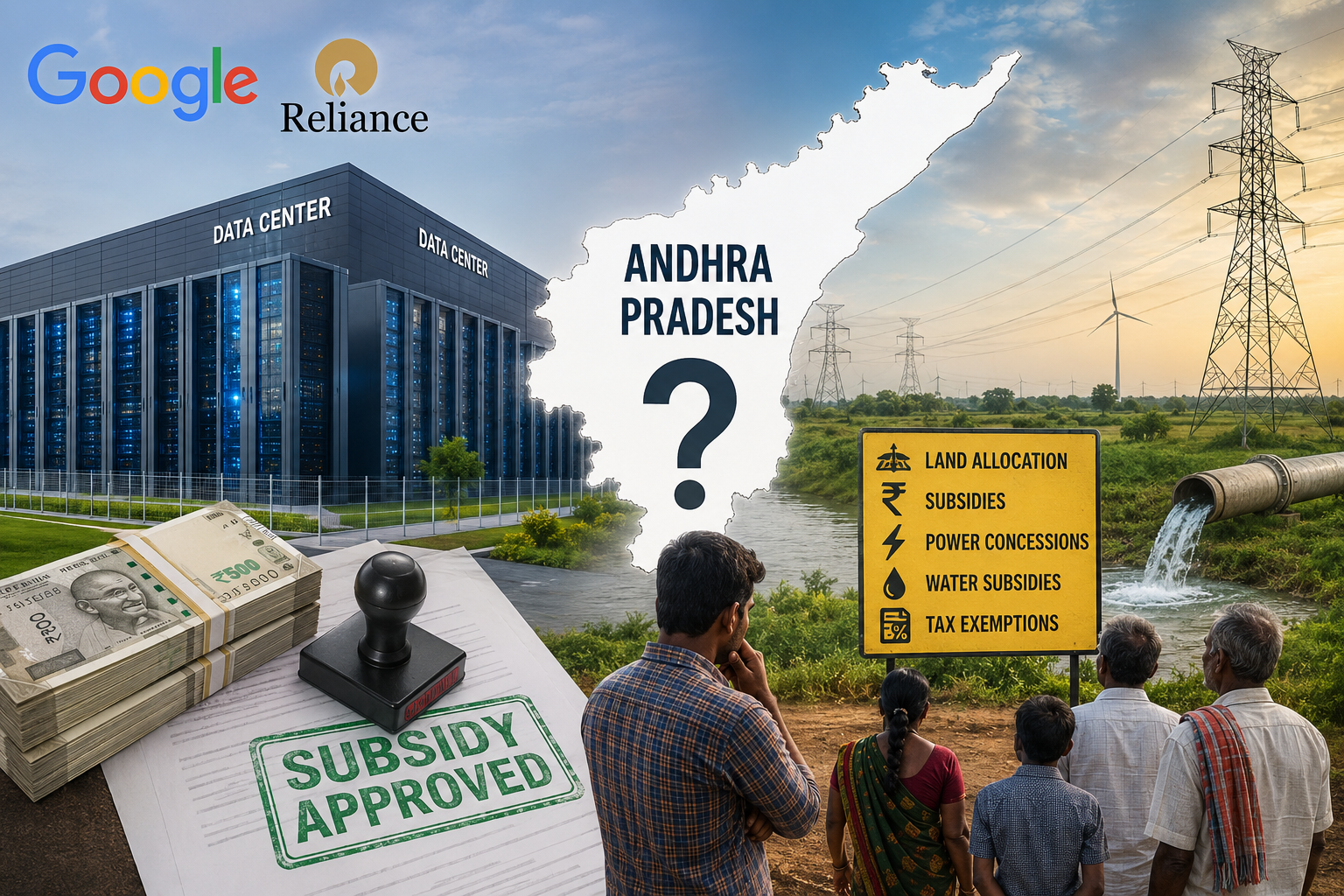
Reports of large-scale investments flowing into Andhra Pradesh have been making headlines consistently. Global giants like Google and Reliance choosing the state for their data centre projects is being seen as a strong signal of development and industrial growth.
However, alongside this optimism, a parallel debate has emerged over the massive incentives being offered by the government—ranging from subsidies worth thousands of crores to land allocations and utility concessions. This has raised a key question: How far should public money be used to attract private investment?
AP Data Centre Subsidies: What Is the Government Offering?
For the proposed data centre projects, the government is reportedly extending substantial incentives. These include:
- Hundreds of acres of prime land
- Subsidies exceeding ₹22,000 crore (as per ongoing discussions)
- Electricity tariff concessions
- Waiver of transmission charges
- Water usage subsidies
- Stamp duty exemptions
- Additional land allocation for power infrastructure
When combined, these incentives reflect a significant utilization of public resources for attracting large-scale investments.
Employment Generation: How Many Jobs Will Be Created?
Despite the massive capital inflow, concerns are being raised about the actual employment potential of data centres.
Experts point out several reasons:
- High level of automation reduces manpower needs
- Limited requirement for human operations
- Very low jobs per acre compared to other industries
- Significantly fewer employment opportunities compared to IT parks or manufacturing units
As a result, many argue that while investment figures look impressive on paper, job creation remains relatively minimal.
Why Are People Questioning These Projects?
The criticism is not necessarily about the investments themselves, but about the real benefit to the public.
Key concerns include:
- Small and medium industries struggling to access finance
- Youth migration to other states in search of jobs
- Manufacturing sector waiting for stronger incentives
- Opinion that the same subsidies could have generated more employment if directed toward MSMEs or manufacturing units
This has triggered a broader debate on whether policy priorities are aligned with employment generation.
Impact on the Local Economy
A typical IT company brings an ecosystem of economic activity around it—such as housing, restaurants, transport, and small businesses—boosting the local economy significantly.
In contrast, data centres tend to have a different profile:
- Highly secured, enclosed infrastructure
- Minimal human workforce
- High electricity consumption
- Significant water usage
- Limited indirect employment opportunities
This raises concerns about whether such projects create meaningful economic circulation at the local level.
The Core Question: What Is the Real Public Benefit?
Bringing global companies to the state is undoubtedly seen as a positive development step. However, when public land, water, electricity, and financial incentives are used on such a large scale, questions naturally arise.
Beyond the numbers of investment, the real evaluation points remain:
- How many jobs are actually created?
- How much does the local economy benefit?
- What tangible improvements reach the common people?
Conclusion
Development is not defined only by the size of investments or the presence of global companies. True progress is reflected in how much it improves people’s lives, strengthens local economies, and creates sustainable employment opportunities.
The ongoing debate in Andhra Pradesh highlights this crucial balance between attracting big investments and ensuring meaningful public benefit.