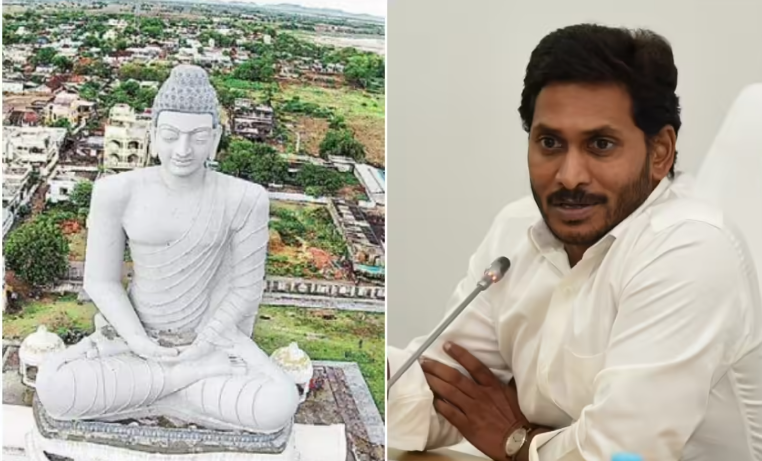
Political Debate Over Jagan’s Stand on the Capital
The campaign by sections of the ruling party claiming that former Andhra Pradesh Chief Minister YS Jagan Mohan Reddy has repeatedly changed his stand on the state’s capital is being described by some political analysts as a mix of half-truths and misleading narratives.
According to these analysts, Jagan’s opposition was never to the idea of establishing a state capital itself. Instead, they argue that his consistent objection has been to the acquisition of fertile agricultural land through the Land Pooling Scheme (LPS) and to the enormous financial burden associated with the Amaravati capital project.
2014: Support for a Capital Near Vijayawada, Not Land Pooling
After N. Chandrababu Naidu assumed office as Chief Minister on June 8, 2014, the government announced on September 4, 2014, that the new capital would be established near Vijayawada.
At that stage, Jagan welcomed the decision and suggested that the capital be constructed on nearly 30,000 acres of existing government land in the region. Political observers point out that there was no proposal at that time to acquire land from farmers across 29 villages through the Land Pooling Scheme.
They also argue that the ruling party’s claim that Jagan had endorsed Amaravati in the Assembly is misleading, since the name “Amaravati” had not yet been officially proposed or discussed in the Assembly during that period.
December 2014: Opposition Began After Land Pooling Announcement
The controversy emerged after the government announced on December 22, 2014, that it would acquire farmers’ lands from 29 villages located between Vijayawada and Guntur along the Krishna River basin through the Land Pooling Scheme for constructing the capital.
Jagan strongly opposed the proposal, alleging that fertile agricultural land was being converted into a large-scale real estate venture and accusing the government of creating a new class of landlords.
Subsequently:
- December 30, 2014: The Andhra Pradesh CRDA Act came into force.
- April 1, 2015: The government officially named the capital region Amaravati.
Boycott of Amaravati Foundation Ceremony
On October 22, 2015, Jagan boycotted the Amaravati foundation stone-laying ceremony.
At the time, he reiterated that he opposed constructing the capital on fertile agricultural lands and maintained that farmers’ interests should not be sacrificed for such a project.
Three Capitals Proposal After Coming to Power
After coming to power in 2019, Jagan’s government introduced the policy of decentralized development, citing the state’s financial constraints.
The proposal suggested:
- Visakhapatnam as the Executive Capital
- Amaravati as the Legislative Capital
- Kurnool as the Judicial Capital
The government argued that balanced regional development would prevent excessive concentration of infrastructure and investments in a single region.
Supporters of Jagan contend that critics ignored the fact that Amaravati continued to remain one of the proposed capitals and instead portrayed the move as an attempt to completely shift the capital.
Financial Concerns Over Amaravati Project
Jagan also repeatedly questioned the financial viability of constructing Amaravati in its proposed form.
He argued that:
- The core capital project would require investments running into lakhs of crores of rupees.
- Heavy borrowing from institutions such as the World Bank and NABARD would place a long-term burden on the state’s finances.
- Depreciation of the Indian rupee could further increase the repayment burden on foreign loans.
- Developing roads, drainage, electricity and other infrastructure on fertile agricultural lands would significantly increase construction costs.
According to some economists cited by his supporters, these financial concerns deserved serious consideration.
Alternative Capital Development Proposal
After losing the elections, Jagan suggested that the government reconsider what he described as an expensive brownfield capital model.
As an alternative, he proposed developing the Machilipatnam–Vijayawada–Guntur corridor within the CRDA limits as a lower-cost administrative region.
According to this proposal, utilizing areas that already possess basic infrastructure could save thousands of crores of public money while still ensuring administrative efficiency.
Fresh Debate Over Amaravati Expansion
The recent discussions surrounding Amaravati’s expansion and the proposed second phase of land acquisition have once again revived the debate.
Critics question how a project initially projected to be developed on 33,000 acres as a Singapore-style capital is now being described as requiring additional land, with claims that the existing area may only be sufficient for a municipality.
Questions are also being raised regarding the expenditure on flood mitigation and related infrastructure projects.
Some critics continue to argue that the Amaravati model resembles a large-scale real estate venture rather than a people-centric capital development project.
Political Narrative vs. Jagan’s Original Position
Supporters of Jagan and several political analysts maintain that he never opposed the establishment of a capital for Andhra Pradesh.
Instead, they argue that his consistent objections were directed at:
- Acquisition of fertile agricultural land through compulsory land pooling.
- The high-cost capital model that they believe exceeds the state’s financial capacity.
- The long-term debt burden associated with the Amaravati project.
They further contend that the narrative portraying Jagan as someone who first supported Amaravati and later completely opposed it is a politically driven campaign built on selective interpretation of events.
Conclusion
The debate over Andhra Pradesh’s capital continues to remain one of the state’s most contentious political issues. While the ruling party accuses YS Jagan Mohan Reddy of repeatedly changing his position, his supporters argue that his stance has remained consistent throughout—that he opposed neither the concept of a capital nor the Amaravati region itself, but rather the methods of land acquisition and the financial model adopted for its development.
As discussions over Amaravati’s expansion, additional land acquisition, and future capital planning continue, the differing interpretations of Jagan’s position are likely to remain a significant part of Andhra Pradesh’s political discourse.