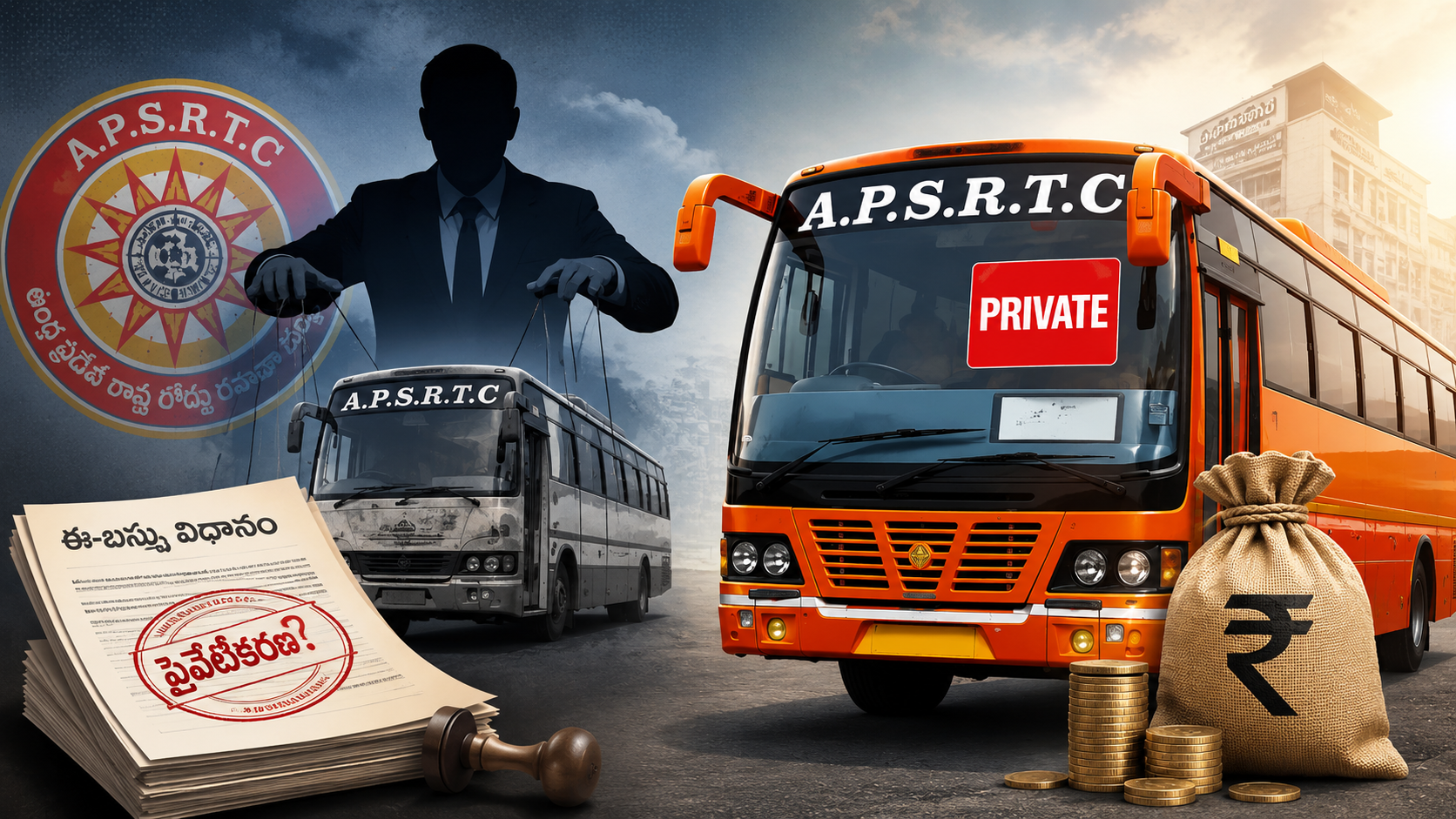
The Andhra Pradesh government, led by Chief Minister N. Chandrababu Naidu, is facing mounting criticism over its proposed electric bus (e-bus) policy, with opposition voices alleging that it marks another major step toward the gradual privatization of the Andhra Pradesh State Road Transport Corporation (APRTC). Critics claim the policy has been designed to provide substantial financial benefits to private operators while shifting the economic burden onto the state-owned transport corporation.
One of the most controversial aspects of the proposal is the provision allowing private operators to seek revisions in the per-kilometre operating charges every six months, while APRTC would bear the additional financial burden. This has sparked debate over whether the policy is intended to modernize public transport or primarily benefit private companies.
APRTC E-Bus Privatization
Is This the Real Strategy Behind the E-Bus Policy?
The Andhra Pradesh government has decided to gradually replace diesel buses operating in the state with electric buses as part of its public transport modernization initiative.
However, instead of operating these buses directly through APRTC, the government is reportedly planning to hand over their operation to private companies under a Gross Cost Contract (GCC)-type model.
According to reports, the government has proposed paying private operators ₹74.50 per kilometre for operating the buses.
Under the proposed payment structure:
- The Central Government would contribute ₹24.50 per kilometre.
- The remaining ₹50 per kilometre would be paid by APRTC.
This means that the primary financial responsibility for operating the buses would rest with APRTC.
Private Operators Get the Right to Seek Fare Revisions
The most controversial provision in the proposed policy concerns the pricing mechanism.
As per the reported proposal:
- Private operators would be allowed to seek revisions in the per-kilometre operating charges once every six months.
- The authority to propose these revisions would reportedly rest with the private companies themselves.
If operators argue that the existing rate of ₹74.50 per kilometre is no longer viable, they could approach the government seeking an increase.
Critics allege that the policy effectively creates a built-in mechanism for periodic rate hikes, benefiting private operators over the long term.
Central Share Remains Fixed, APRTC Bears the Entire Additional Burden
Even if the operating charges are revised upward, the Central Government’s contribution of ₹24.50 per kilometre is unlikely to increase.
As a result:
- Any increase in the contract rate would have to be paid entirely by APRTC.
- Every future revision would therefore increase the corporation’s financial burden.
Transport experts have expressed concerns that repeated cost escalations could significantly weaken APRTC’s financial position.
Why Special Concessions for E-Bus Contracts?
Critics point out that existing diesel bus contracts awarded to private operators do not contain such provisions.
In current diesel bus agreements:
- The contract rate is fixed at the time of tender.
- The agreed rate generally remains unchanged throughout the contract period.
However, under the proposed e-bus policy:
- Rates can be revised every six months.
- Revisions can reportedly be initiated by private operators.
- The additional financial burden would fall entirely on APRTC.
These differences have raised questions about why special concessions are being extended exclusively to e-bus operators.
1,450 E-Buses in Phase One; Target of 10,000 by 2029
The government has announced plans to introduce 1,450 electric buses in the first phase.
It has also set a target of operating 10,000 e-buses across Andhra Pradesh by 2029.
If implemented as planned, a substantial portion of the state’s public transport system would eventually depend on privately operated electric buses.
Will APRTC Lose While Private Firms Gain?
Critics argue that the proposed policy creates an imbalance between APRTC and private operators.
According to them:
- Contract rates could increase every six months.
- The Central Government’s contribution would remain unchanged.
- APRTC would shoulder the entire additional financial burden.
- Private companies would continue to enjoy rising revenues.
This, they argue, could gradually weaken APRTC’s finances while ensuring steady profits for private operators.
Are Contracts Being Tailored for Select Companies?
Allegations have also surfaced that the policy has been structured in a manner that could favour companies allegedly close to those in power.
Critics claim the proposed framework includes several provisions beneficial to private operators, including:
- The right to seek periodic rate revisions.
- Long-term contracts.
- Financial protection through APRTC absorbing increased costs.
According to critics, these provisions could generate substantial long-term profits for private companies while placing increasing financial pressure on the public transport corporation.
Officials and employee groups within APRTC have also reportedly expressed concerns that the policy could weaken the corporation’s financial foundation in the years ahead.
Will APRTC Be Protected or Gradually Privatized?
While the Andhra Pradesh government maintains that the e-bus policy is aimed at modernizing public transportation and promoting cleaner mobility, the proposed contractual terms have generated significant political and public debate.
Critics argue that allowing private operators to seek periodic increases in operating charges, while requiring APRTC to absorb all additional costs, raises serious questions about the long-term sustainability of the corporation.
They also point to the government’s plan to deploy thousands of privately operated electric buses as evidence of a broader shift toward privatization.
As the debate intensifies, critics say the government must clearly explain whether the policy is intended primarily to improve public transport services or whether it disproportionately benefits private operators at the expense of the state-run transport corporation.