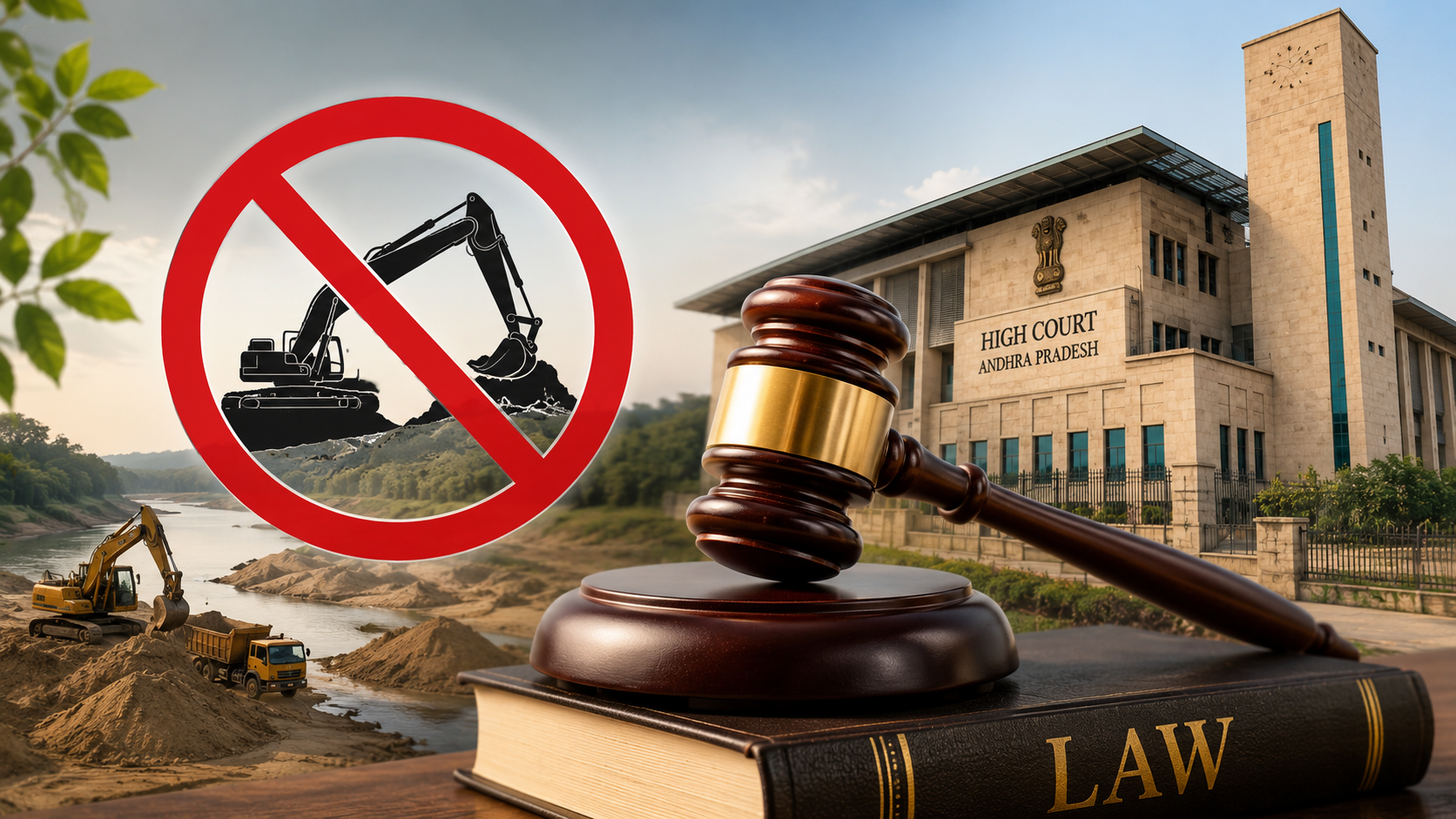
In a landmark judgment on environmental protection, the Andhra Pradesh High Court has delivered a strong message to the State Government regarding the conservation of natural resources. The Court observed that air, water, forests, rivers, lakes, ponds, and other natural resources do not belong to the government. Instead, the government acts only as a trustee responsible for protecting these resources on behalf of the people.
The Court made it clear that governments do not have unlimited powers to exploit natural resources in the name of development. It also directed authorities to strictly implement environmental laws and ensure compliance with the Standard Operating Procedure (SOP) governing sand and earth excavation, particularly around water bodies.
High Court Cancels Vizianagaram Collector’s Proceedings
The observations came while hearing a case related to permissions granted for sand and earth excavation for road construction works in Vizianagaram district.
The High Court set aside the proceedings issued by the District Collector and laid down several important guidelines for protecting natural resources and ensuring sustainable development.
Natural Resources Belong to the People, Not the Government
One of the most significant observations made by the Court was that natural resources such as air, water, forests, rivers, lakes, ponds, and wetlands are public assets.
The government has no ownership rights over these resources.
Instead, it serves as a trustee with a constitutional duty to preserve and protect them for present and future generations.
High Court Reiterates the Public Trust Doctrine
The Court relied upon the Public Trust Doctrine, a well-established legal principle in environmental jurisprudence.
According to this doctrine:
- Natural resources belong to the people.
- The government is only a trustee, not the owner.
- The government cannot sell, misuse, or allow exploitation of these resources.
- Natural resources must be protected solely for public benefit.
The Court observed that any governmental decision violating this doctrine cannot withstand judicial scrutiny.
Constitution Also Mandates Environmental Protection
The High Court referred to several constitutional provisions emphasizing environmental conservation.
Article 21
Every citizen has the fundamental right to live in a clean and healthy environment.
Article 48A
It is the constitutional duty of the State to protect and improve the environment, forests, and wildlife.
Article 51A(g)
Every citizen also has a fundamental duty to protect and improve the natural environment.
The Court emphasized that governments cannot encourage activities that damage the environment.
High Court Comes Down Heavily on Sand and Earth Excavation Near Water Bodies
The Court strongly criticized indiscriminate sand and earth excavation around rivers, streams, lakes, tanks, and reservoirs.
It directed that:
- Unregulated excavation near water bodies should not be permitted.
- Activities causing environmental degradation must not be allowed.
- Extraction of natural resources should be permitted only after obtaining all statutory approvals.
- Authorities must assess environmental impact before granting permissions.
Development Cannot Come at the Cost of Nature
The Court acknowledged that roads, public infrastructure, and development projects are necessary.
However, it observed that development cannot be used as an excuse to destroy nature.
The judgment stressed that governments must follow the principles of Sustainable Development, ensuring that developmental activities do not cause irreversible environmental damage.
The Court remarked:
“Development is necessary, but not at the cost of environmental destruction.”
Contractors Are Not Rendering Free Service to the Government
In one of its strongest observations, the High Court pointed out that contractors executing government projects are not rendering free public service.
Instead:
- They receive substantial public funds.
- They earn significant commercial profits.
- Therefore, they are equally bound by environmental laws, mining regulations, and statutory requirements.
The Court clarified that government contracts do not grant immunity from legal compliance.
Sand and Earth Excavation Without Legal Permissions is Illegal
The High Court categorically stated that sand and earth excavation cannot be carried out without obtaining:
- Environmental clearances
- Mining permissions
- Statutory approvals under applicable laws
The Court further observed that even government departments are not above the law.
Mandatory Implementation of Standard Operating Procedure (SOP)
The Court directed the State Government to strictly implement the Standard Operating Procedure (SOP) governing sand and earth excavation.
No government department, authority, or official should bypass the SOP while granting permissions or executing projects.
Annual Review by the Chief Secretary Ordered
To ensure effective implementation of environmental laws, the High Court directed the State Chief Secretary to conduct an annual review covering:
- Implementation of the SOP
- Enforcement of environmental laws
- Prevention of illegal mining and excavation
- Performance of district-level authorities
The Court stressed that regular monitoring is essential for effective conservation of natural resources.
Vizianagaram Collector’s Proceedings Quashed
The High Court quashed the proceedings issued by the Vizianagaram District Collector.
It held that the permissions were granted without adequately considering environmental protection laws, mining regulations, constitutional principles, and the government’s obligation to safeguard natural resources.
Therefore, the permissions could not be sustained in law.
Key Observations Made by the High Court
- Air, water, forests, rivers, and lakes are gifts of nature.
- Natural resources are public assets, not government property.
- The government acts only as a trustee on behalf of the people.
- Protecting natural resources is a constitutional obligation.
- Indiscriminate sand and earth excavation near water bodies cannot be permitted.
- Contractors executing government works must fully comply with environmental and mining laws.
- Excavation without statutory approvals is illegal.
- The Standard Operating Procedure (SOP) must be implemented without exception.
- The Chief Secretary must conduct annual reviews on environmental compliance.
- Governments must preserve natural resources for future generations.
Why This Judgment is Significant
This judgment is not confined to Vizianagaram district alone.
It is expected to serve as a guiding precedent for future government decisions concerning:
- Sand mining
- Earth excavation
- Gravel extraction
- Environmental clearances
- Sustainable use of natural resources
The ruling sends a strong message that development cannot override environmental protection and constitutional responsibilities.
It reinforces the principle that governments are custodians not owners of public natural resources.
“Do Not Destroy Nature”: The High Court’s Final Message
The Andhra Pradesh High Court concluded with a clear and powerful message:
“Do not destroy nature.”
The Court emphasized that natural resources are not revenue-generating assets for the government but the lifeline of the people.
Protecting them is a constitutional responsibility owed not only to the present generation but also to future generations.
It further clarified that government departments, officials, and contractors are all equally bound by environmental laws, and no one is above the law.
The judgment is expected to have far-reaching implications for environmental governance, natural resource management, mining permissions, and government decision-making across Andhra Pradesh.