Mavigan Proposal Sparks Fresh Political Debate
The issue of Andhra Pradesh’s capital has once again become the center of political discussion. YSR Congress Party (YSRCP) president and Leader of the Opposition Y.S. Jagan Mohan Reddy recently unveiled his vision for the state’s future capital development by proposing Mavigan—an integrated development model connecting Machilipatnam, Vijayawada, and Guntur.
Addressing the media, Jagan announced that Mavigan would be officially included in the party’s manifesto for the next Assembly elections. He stated that voters who support this development model would back YSRCP, while those who prefer development limited to the 29 villages of Amaravati would support the Telugu Desam Party (TDP).
His remarks have reignited the political debate, with “Amaravati vs. Mavigan” becoming a widely discussed topic across political circles, social media, and digital platforms.
Continuing Criticism of the Amaravati Project
Even before the Mavigan proposal, YSRCP had consistently criticized the Amaravati capital project over its construction costs and financial viability. Several experts from the construction sector have also raised questions regarding project expenditures, land allocation, tender values, and debt management.
According to critics, Central Government office buildings are reportedly being constructed at approximately ₹4,645 per square foot, whereas the estimated cost for Andhra Pradesh Secretariat Towers has been placed at nearly ₹20,497 per square foot, which they describe as unusually high.
They argue that private developers can construct commercial buildings for around ₹5,000–6,000 per square foot, despite purchasing land and bearing material costs. Therefore, they question why government projects—with access to land and resources such as sand—are estimated at significantly higher costs.
Critics also point to the sharp increase in project costs. They claim that the tender value for five Secretariat towers rose from ₹2,271 crore in 2018 to approximately ₹10,665 crore. Similarly, while the national average cost of highway construction is around ₹24 crore per kilometre, Amaravati roads are reportedly estimated at ₹53 crore per kilometre, and flyovers at ₹189 crore per kilometre, raising further concerns.
Another allegation involves land valuation. Critics claim that land submitted to the World Bank was valued at ₹50,000 per square yard, whereas actual market transactions in 2025 reportedly indicated prices of around ₹7,500 per square yard. Questions have also been raised regarding land allotments, with allegations that certain influential individuals received preferential treatment while many farmers who surrendered land were allocated plots in flood-prone areas.
Rising Debt and Financial Burden
Critics further argue that approximately ₹47,387 crore has already been borrowed for the Amaravati project, with interest rates ranging between 8% and 10%.
According to their estimates, the state treasury may have to spend nearly ₹9,200 crore between 2025 and 2027, which they say contradicts the government’s claim that Amaravati is a “self-financing” project.
Analysts also suggest that it could take decades for Amaravati to develop into a city capable of competing with metropolitan centres such as Hyderabad, Bengaluru, and Chennai. By then, they argue, those cities would have advanced even further. Estimates cited by critics suggest that completing Amaravati’s infrastructure could ultimately require investments ranging from ₹2 lakh crore to ₹5 lakh crore.
Meanwhile, reports circulating in the public domain claim that state debt has reached around ₹3.55 lakh crore within 25 months of the coalition government taking office. It has also been alleged that the government maintained the Reserve Bank of India’s minimum cash balance requirement for only eight days, relying on Special Drawing Facility (SDF), Ways and Means Advances (WMA), and overdrafts during the remaining period.
What is Mavigan?
Mavigan is a proposed integrated economic corridor connecting Machilipatnam, Vijayawada, and Guntur into a unified metropolitan region.
YSRCP describes the concept as a development model that leverages existing infrastructure instead of constructing an entirely new capital city from scratch. According to the proposal, the required infrastructure could be developed with an investment of around ₹20,000 crore, significantly lower than the estimated cost of developing Amaravati.
Claimed Advantages of the Mavigan Model
Supporters argue that Mavigan benefits from the existing infrastructure already available across the three cities.
These include:
- Machilipatnam Port
- Vijayawada International Airport
- Educational institutions in Guntur
- Established railway stations
- National highways and transport connectivity
They believe that developing these three cities as a single economic corridor would attract industrial investment, reduce logistics costs, increase land values from Machilipatnam to Guntur, and generate direct economic benefits for people across at least three districts.
Supporters further argue that since most infrastructure already exists, there would be minimal need for large-scale land acquisition, reducing both project costs and financial pressure on the state.
Growing Support for Mavigan on Digital Platforms
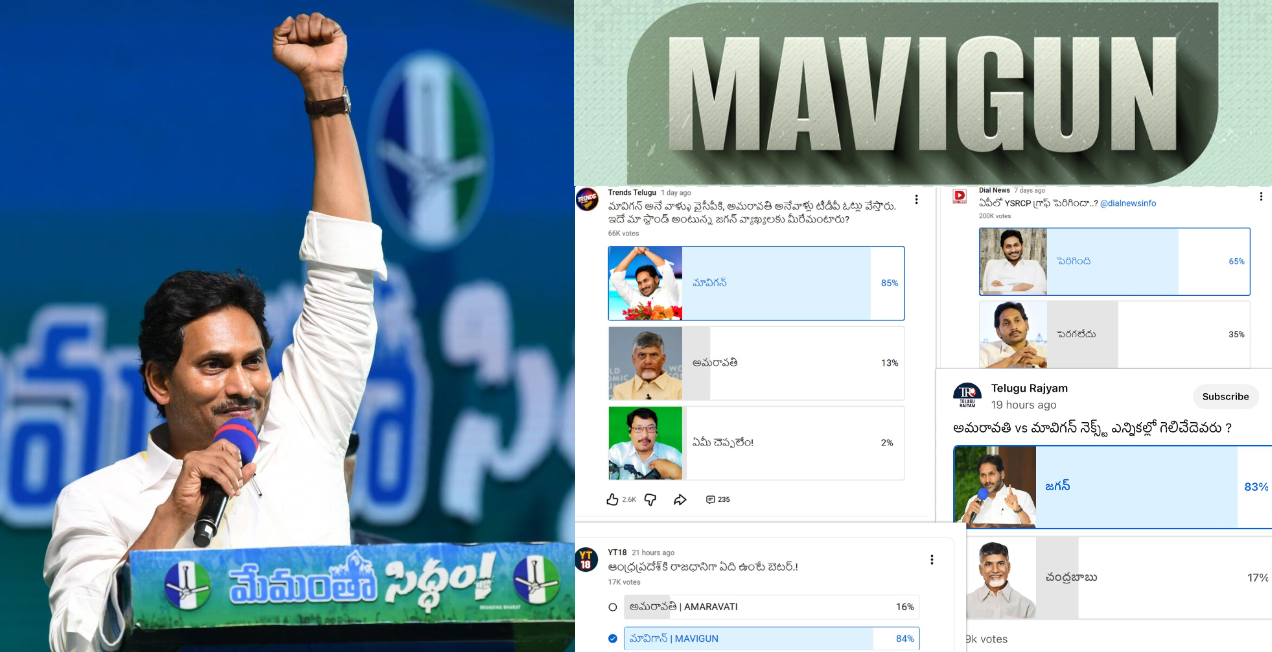
Following Jagan’s announcement, several opinion polls were conducted across YouTube channels, digital media platforms, and social media.
Many of these polls indicated strong support for the Mavigan proposal.
Journalist Sai Poll (26,000 Votes)
Question: What is your opinion on Jagan’s statement: “Amaravati is your agenda; Mavigan is ours”?
- Mavigan (Vijayawada–Guntur–Machilipatnam): 63%
- Amaravati (29 villages): 20%
- CRDA Capital Region: 15%
- Cannot Say: 3%
Trends Telugu (66,000 Votes)
Question: Which capital model is better for future generations and long-term development?
- Mavigan: 85%
- Amaravati: 13%
- Cannot Say: 2%
Dial News (200,000 Votes)
Question: Has YSRCP’s political graph improved in Andhra Pradesh?
- Yes: 65%
- No: 35%
Telugu Rajyam (19,000 Votes)
Question: Which agenda is likely to dominate the next election?
- Jagan (Mavigan): 83%
- Chandrababu (Amaravati): 17%
YT18 (17,000 Votes)
Question: Which capital model is best for Andhra Pradesh?
- Mavigan: 84%
- Amaravati: 16%
What Do the Digital Discussions Indicate?
Discussions across digital platforms suggest that the Mavigan proposal has generated significant public interest. Much of the online debate focuses on issues such as the high cost of Amaravati, rising public debt, better utilization of existing infrastructure, and the possibility of achieving more balanced regional development.
At the same time, it is important to note that online polls conducted by media outlets and social media platforms are not scientific surveys and may not accurately represent the views of the entire electorate.
Nevertheless, the volume of digital engagement indicates that the Mavigan proposal has emerged as a major topic of political and public discussion, setting the stage for a renewed debate over Andhra Pradesh’s future capital development model.