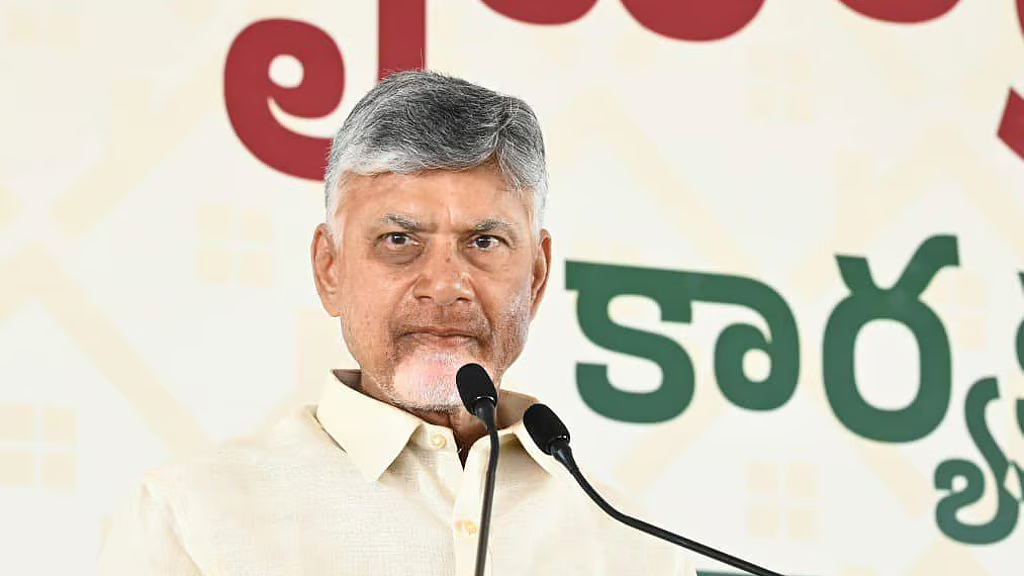
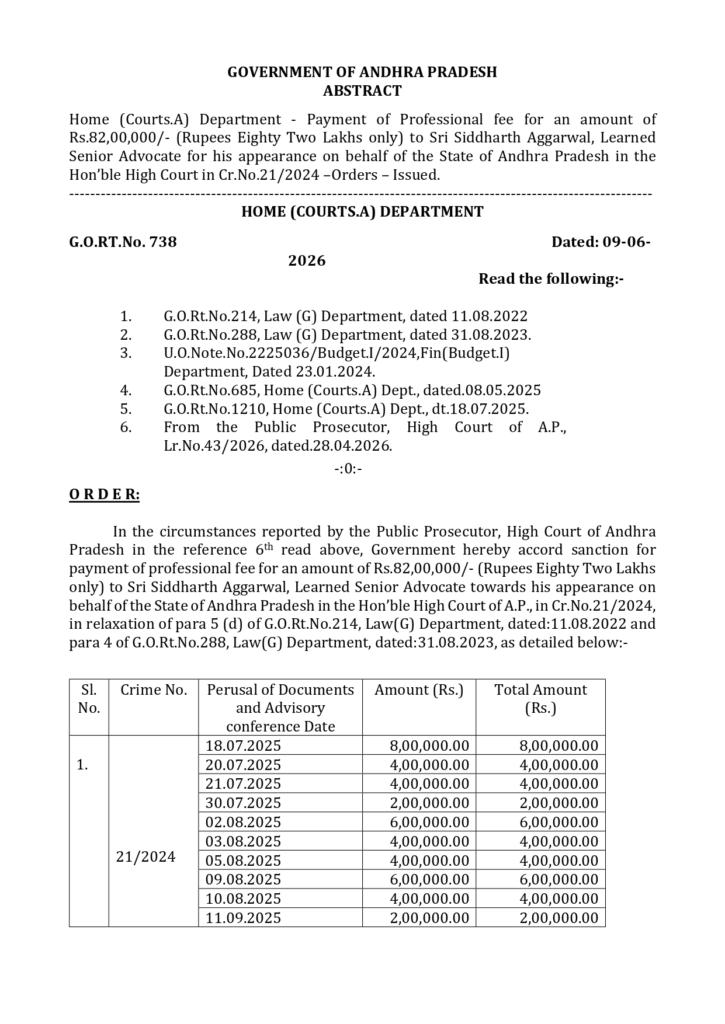
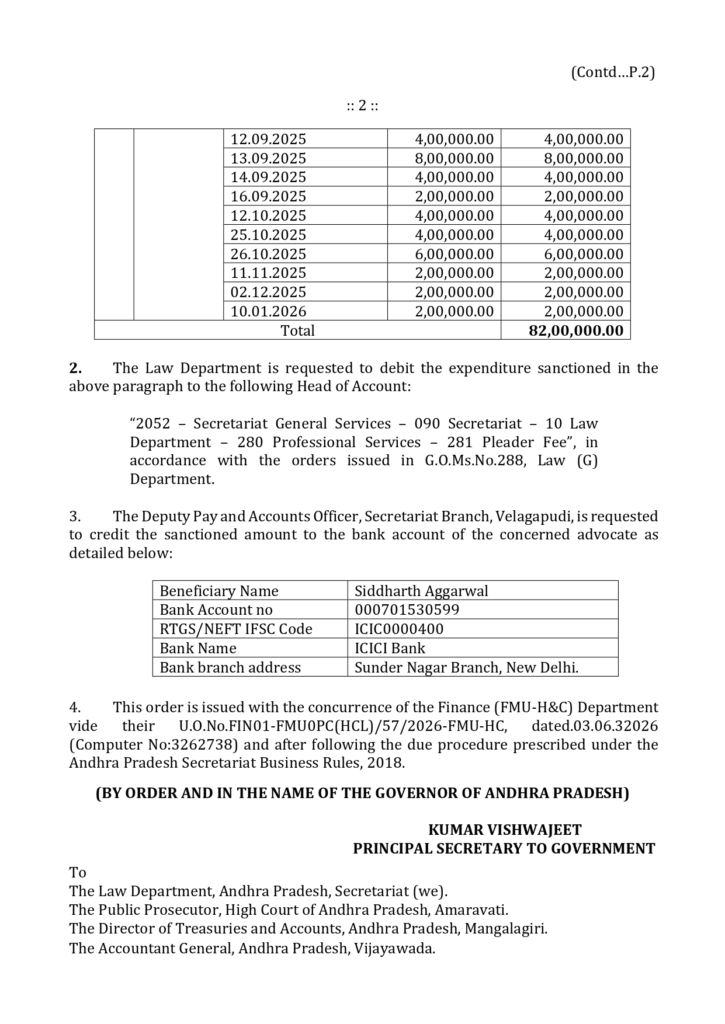
The Government of Andhra Pradesh has issued a Government Order (GO) that has sparked considerable debate. The order authorizes a payment of ₹82 lakh to senior advocate Siddharth Agarwal for representing the state in a High Court case related to Cr.No.21/2024.
According to the GO, the payment covers legal services provided between July 2025 and January 2026. During this period, Siddharth Agarwal advised the government on legal matters and appeared in court on its behalf.
₹82 Lakh Fee Draws Public Attention
The government order states that Siddharth Agarwal will receive a total of ₹82 lakh for his services. The payment includes different amounts for different assignments. For instance, he was paid ₹2 lakh for one appearance and ₹8 lakh for another, depending on the nature of the work involved.
The decision has raised questions among the public. Many people feel that ₹82 lakh is a substantial amount of taxpayer money to be spent on legal fees and are asking whether such an expenditure is justified.
Contrast With Compensation Demands for Steel Plant Workers
The controversy has intensified because of another issue currently in the public eye. Families of workers who lost their lives in the recent accident at the Visakhapatnam Steel Plant have been demanding compensation of at least ₹1 crore for each affected family.
However, they say they have not received a clear response regarding their demands. This has led many people to compare the two situations. On one hand, the government has approved ₹82 lakh for a senior advocate, while on the other, families grieving the loss of their loved ones continue to seek adequate compensation.
Public Money and Spending Priorities
The issue has triggered a broader discussion about how public money should be spent. Many people are questioning whether taxpayer funds should be directed toward expensive legal expenses or whether greater priority should be given to the welfare of workers, farmers, and economically weaker sections of society.
The government order has also prompted calls for greater transparency and accountability in public spending. People want to understand the reasoning behind such decisions and the priorities guiding them.
Political Reactions and Opposition Criticism
Opposition parties have criticized the government’s decision, arguing that it reflects inconsistent priorities. They question why the government was quick to approve a large payment for legal representation while families of deceased workers are still waiting for clarity on compensation.
As a result, the issue has evolved into a wider debate about what the government’s priorities should be and how decisions involving public funds ought to be made.
Was This a Routine Legal Expense or a Special Approval?
Some observers have also asked whether the ₹82 lakh payment was part of the government’s standard legal expenditure or whether it required special approval due to its size.
They believe the government should clearly explain whether such payments are routine practice and provide details about the factors that led to this particular decision. Greater clarity, they argue, would help address public concerns.
Calls for Transparency and Worker Justice
The controversy has renewed demands for transparency in the use of public funds. Citizens want governments to be more open about how taxpayer money is allocated and spent.
At the same time, many people have expressed sympathy for the families of the steel plant workers who lost their lives. They believe these families deserve timely and fair compensation, and that the government should respond to their concerns with urgency and compassion.
A Debate Over Priorities
The ₹82 lakh payment has ultimately become more than just a discussion about legal expenses. It has sparked a larger debate about government priorities, accountability, and the use of public money.
People are asking whether such decisions are based solely on administrative necessity or whether they also reflect what is fair and just for ordinary citizens. That question continues to fuel public discussion and political debate.