The Andhra Pradesh government is facing criticism over its spending on publicity campaigns while several welfare-related issues and pending payments remain under discussion. The latest controversy concerns a tender inviting agencies to produce and publish a government podcast series featuring the Chief Minister, ministers, district collectors, and beneficiaries of welfare schemes.
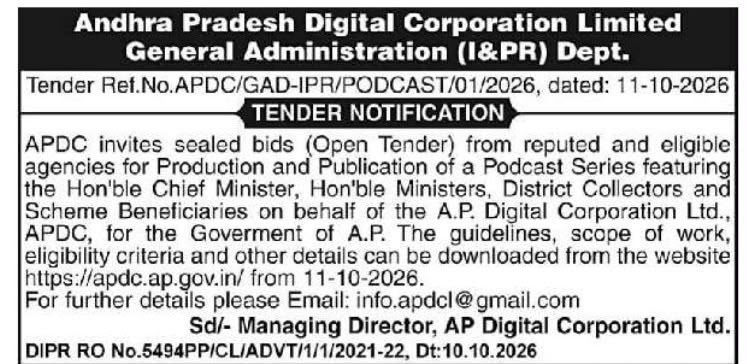
According to a tender notification dated October 11, 2026, issued through Andhra Pradesh Digital Corporation Limited under the Information and Public Relations Department, eligible agencies have been invited to submit bids for the podcast project. The move has raised questions about the government’s publicity expenditure and its priorities amid concerns over the implementation of welfare schemes.
AP Government Podcast Series Tender 2026
The proposed government podcast series is expected to feature political leaders, district officials, and beneficiaries discussing government initiatives and welfare programmes.
However, critics argue that the government should clarify the estimated cost of the project, its objectives, and the expected benefits for the public. With several digital publicity initiatives already underway, the proposed podcast campaign has triggered a wider debate over the use of public funds.
The key question is whether the expenditure will provide meaningful public information or primarily serve as a government image-building exercise.
Welfare Schemes and Pending Payments Under Scrutiny
The government is also facing questions over the implementation of election promises and the settlement of pending dues.
Issues highlighted by critics include the promised unemployment allowance, the proposed monthly payment of Rs. 1,500 under the Aadabidda Nidhi scheme, pending payments under Vidya Deevena and Vasathi Deevena, Aarogyasri dues, and outstanding Dearness Allowance (DA) and Pay Revision Commission (PRC) arrears for government employees.
Opposition parties have questioned why publicity campaigns are receiving attention while beneficiaries, unemployed youth, women, and government employees continue to raise concerns about these issues.
The government’s response and the current implementation status of the individual schemes remain important factors in assessing these criticisms.
AP Government Social Media Influencer Policy and Digital Publicity Spending
The Andhra Pradesh government has also introduced a Social Media Influencer Policy as part of its digital communication strategy.
According to claims cited in the political debate, the policy provides for the empanelment of content creators with follower counts ranging from 10,000 to more than one lakh. The reported payment structure allows eligible influencers to receive up to Rs. 1.50 lakh per month, subject to the applicable conditions.
The policy has attracted criticism over the potential cost of promoting government programmes through social media platforms.
Other issues raised include reported administrative approvals of Rs. 40 crore for digital publicity, recruitment of social media personnel through the state’s digital corporation, and appointments to manage social media communications in ministers’ offices.
There are also allegations that more than Rs. 160 crore was spent on social media teams over the past two years. These figures require verification through official government orders, expenditure statements, and other public records.
National Media Sponsorships Raise Questions
The government’s sponsorship of national media events has also become part of the debate.
According to the claims cited in the discussion, the Andhra Pradesh government acted as a state sponsor for the annual summit organised by Republic TV in New Delhi, with Rs. 43,83,583 reportedly released for the event. The state also reportedly participated as a state sponsor partner in the India Today Conclave held in Kochi.
These sponsorships have raised questions about the purpose of government spending on national media events.
Critics argue that the government should provide details about the objectives, contractual terms, and public benefits of such sponsorships. They also want greater transparency regarding whether these initiatives are intended to communicate public policies or enhance the image of political leaders.
Former Village and Ward Volunteers Raise Concerns
The status of Andhra Pradesh’s village and ward volunteer system is another issue in the debate.
The state previously had around 2.66 lakh village and ward volunteers who helped deliver services to residents, including during the COVID-19 pandemic and floods.
Former volunteers and opposition leaders have expressed dissatisfaction over the system’s treatment and the status of promises made to volunteers and their families.
They have questioned the reported spending on social media influencers and publicity teams while issues affecting former volunteers remain unresolved.
The debate has therefore expanded beyond the proposed podcast tender to include employment, welfare delivery, public expenditure, and the government’s communication strategy.
How Much Will the Andhra Pradesh Government Podcast Campaign Cost?
The proposed podcast project has brought renewed attention to the balance between government publicity and welfare expenditure.
The actual cost of the podcast series, the number of episodes, the production requirements, and the terms of the contract need to be established from the tender documents and any subsequent award details.
Critics are demanding greater transparency regarding digital publicity budgets, influencer payments, media sponsorships, and the results achieved through these initiatives.
For the public, the central concern is whether government communication expenditure delivers measurable benefits, such as improved awareness of welfare schemes, easier access to services, and better information about eligibility and application procedures.
Conclusion
The Andhra Pradesh government’s proposed podcast series has triggered a broader debate over public funds, digital publicity, and welfare priorities. While government communication can help citizens understand public programmes, questions remain about the cost-effectiveness and transparency of these campaigns.
As the debate continues, the disclosure of tender costs, expenditure records, and measurable outcomes could help the public assess whether these initiatives offer value for money while welfare commitments and pending payments remain important concerns.