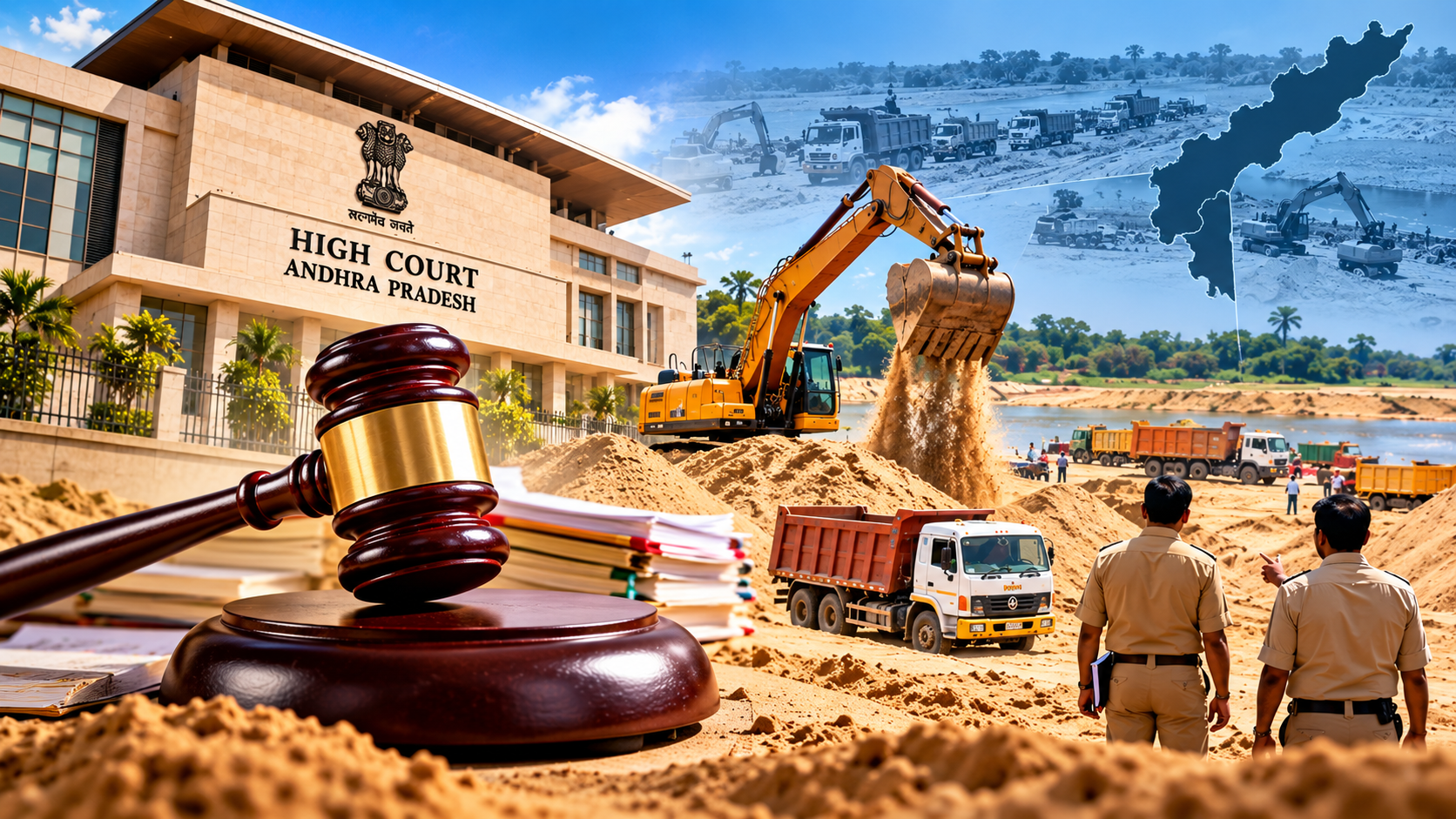
The Andhra Pradesh High Court has taken a serious view of illegal sand and soil excavation in the state and stressed the government’s responsibility to protect natural resources. The court said there must be a strong monitoring system to prevent excavation in violation of rules.
The court’s observations have once again brought focus on illegal sand mining in Andhra Pradesh, unauthorised excavation near water bodies and the need for effective field-level monitoring.
AP High Court on Illegal Sand Mining
Sand and soil are important natural resources, particularly for the construction sector. However, their extraction must be carried out according to the rules and within permitted limits.
The High Court stressed that natural resources cannot be treated as private property. The government has a responsibility to protect these resources in the public interest and ensure that they are used in a regulated manner.
The court’s directions underline the need for authorities to prevent unauthorised sand mining and soil excavation, particularly around rivers and other water resources.
‘No Staff for Inspections’ Cannot Be an Excuse
One of the key issues is the availability of staff for inspections.
Authorities are expected to check whether sand excavation is being carried out with proper permission and whether the permitted quantity and conditions are being followed. They also need to monitor the use of heavy machinery and the transportation of excavated material.
Simply stating that there are not enough personnel to conduct inspections cannot become a reason for allowing violations to continue.
An effective monitoring mechanism is therefore important to identify illegal excavation at the field level and take timely action.
Who Is Responsible When Illegal Mining Happens?
The High Court’s observations also raise an important administrative question: who is responsible when illegal sand mining continues without being detected?
Authorities need to monitor:
- Whether sand mining has official permission
- Whether excavation is within the approved limits
- Whether prohibited machinery is being used
- Where the extracted sand is being transported
- Whether transportation rules are being followed
- Whether illegal excavation is taking place near rivers and water bodies
If violations continue despite an official monitoring system, the effectiveness of that system naturally comes under scrutiny.
Need to Protect Natural Resources
Illegal sand mining is not only a regulatory issue. Sand excavation can also have a direct connection with rivers, streams, ponds and other water resources.
The High Court has emphasised the need to protect natural resources for future generations. Excavation without permission or in violation of prescribed conditions is not acceptable.
The court has also directed the government to strictly implement the Standard Operating Procedure (SOP) prepared for the protection and management of natural resources.
This means field-level enforcement is as important as maintaining inspection records.
Government Monitoring System Under Focus
Following the High Court’s directions, the government’s next steps will be important.
The authorities may need to strengthen monitoring mechanisms, clearly define the responsibilities of officials and ensure that adequate personnel are available for inspections.
The focus will also be on how effectively violations are detected and what action is taken against those involved in illegal excavation and transportation.
Recent reports from different parts of Andhra Pradesh have also highlighted concerns over illegal excavation and overloaded sand transportation. Such incidents have increased attention on the enforcement of sand mining regulations.
Strong Field-Level Action Needed
Responding to complaints after illegal mining has already taken place is different from preventing violations in the first place.
The High Court’s directions put the focus on preventive monitoring, effective inspections and strict implementation of existing rules.
For illegal sand mining in Andhra Pradesh to be controlled effectively, the key requirements include a strong monitoring mechanism, clear accountability, regular field inspections and enforcement of the prescribed rules.
The issue now moves to implementation, with the government’s ability to strengthen monitoring and prevent unauthorised excavation likely to remain under close scrutiny.