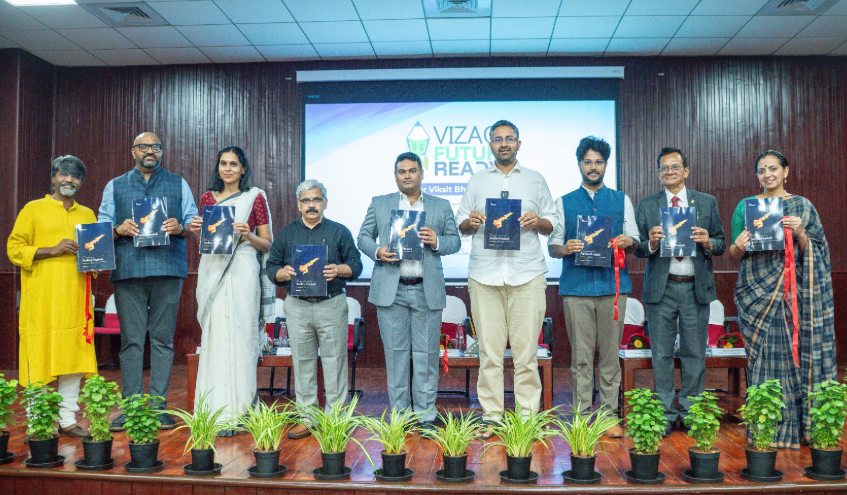
A new report on youth opportunities in Andhra Pradesh has highlighted several concerns regarding employment, unemployment and the overall participation of young people in the state’s economy. The Andhra Pradesh State Handbook of Youth Opportunities was released at GITAM University in Visakhapatnam by MP Sri Bharat under the aegis of the Future India Foundation.
The report assessed all 26 districts of Andhra Pradesh using nearly 180 indicators drawn from 27 government databases. It evaluated the status of youth across five key dimensions — Opportunity, Participation, Work, Education and Skill Development.
Andhra Pradesh Scores Below National State Average
Andhra Pradesh recorded a Youth Power Score of 45.3, below the average score of 47.8 recorded across states.
The state has around 1.23 crore young people, of whom only 46.4 per cent are part of the workforce. The youth unemployment rate stands at 16.2 per cent.
The report also found that 28.4 per cent of young people are neither studying nor engaged in employment or skill training, pointing to a significant challenge in bringing youth into education, employment and skill-development opportunities.
Higher Education Linked to Higher Unemployment
One of the major concerns highlighted by the report is the rise in unemployment with higher levels of education.
Among those with secondary education or below, the unemployment rate stands at around 3 per cent. It rises to 12 per cent among those with higher secondary education.
The situation is more pronounced among college graduates, with 41 per cent reported to be unemployed.
Young Women Face Greater Employment Challenges
The report highlighted a wider employment gap among educated young women.
Around 49 per cent of women who have completed a degree are unemployed, compared with 37 per cent among young men, according to the report.
The figures indicate that completing higher education does not necessarily translate into employment opportunities for a large section of young people, particularly women.
School Infrastructure Shows Improvement
Despite concerns over learning outcomes and employment, the report noted improvements in school infrastructure across the state.
Nearly 99 per cent of schools reportedly have access to electricity, functional toilets for girls and internet facilities.
Education experts have attributed these improvements to the Nadu-Nedu programme introduced by the previous government.
The report also found that the proportion of children experiencing chronic undernutrition declined from 31 per cent to 25 per cent. Educationists have linked the improvement to the Gorumudda scheme.
Internet Access Among Young Women Rises Sharply
Digital access among young women has also recorded substantial growth.
Between 2021 and 2024, internet usage among young women increased from 21 per cent to 64 per cent, according to the report.
The share of young women with bank accounts also rose to 92 per cent, indicating wider access to formal financial services.
Learning Outcomes Remain a Concern
While school infrastructure has improved, learning outcomes continue to remain a challenge.
Only 48 per cent of Class 6 students meet the expected language standards, while just 41 per cent meet the expected mathematics standards.
The report also pointed out a shortage of teachers, stating that approximately one in every three primary schools operates with only a single teacher.
Shift Away From Agricultural Employment
The employment profile of young people has also changed over the past eight years.
The share of youth working in the agriculture sector declined from 43 per cent to 32 per cent.
At the same time, the share of young workers in regular salaried employment increased to 24 per cent.
However, job security remains an issue, with around three out of every 10 young workers relying on temporary or casual employment.
Visakhapatnam Leads Among 26 Districts
Among the 26 districts, Visakhapatnam ranked first with a Youth Power Score of 55.
The district also recorded a significantly higher share of regular salaried employment. Around 60 per cent of young workers in Visakhapatnam are in regular salaried jobs, compared with 21 per cent in the average district.
The economic value generated per worker was also higher in Visakhapatnam. The report estimated it at around ₹1.79 lakh per worker, compared with ₹1.42 lakh in an average district.
Better Education Participation Among Young Women in Visakhapatnam
Visakhapatnam also performed better in terms of educational participation among young women aged 15–21.
The share of young women who were out of education in the district was 15 per cent, compared with 33 per cent in the average district, according to the report.
Employment and Education Remain Key Challenges
Overall, the report presents a mixed picture of youth development in Andhra Pradesh. While school infrastructure, digital access and financial inclusion have improved in several areas, youth unemployment, graduate unemployment, learning outcomes, teacher availability and the prevalence of temporary employment remain significant challenges.
The findings underline the gap between improvements in access and infrastructure on one hand and the availability of quality education and stable employment opportunities on the other.