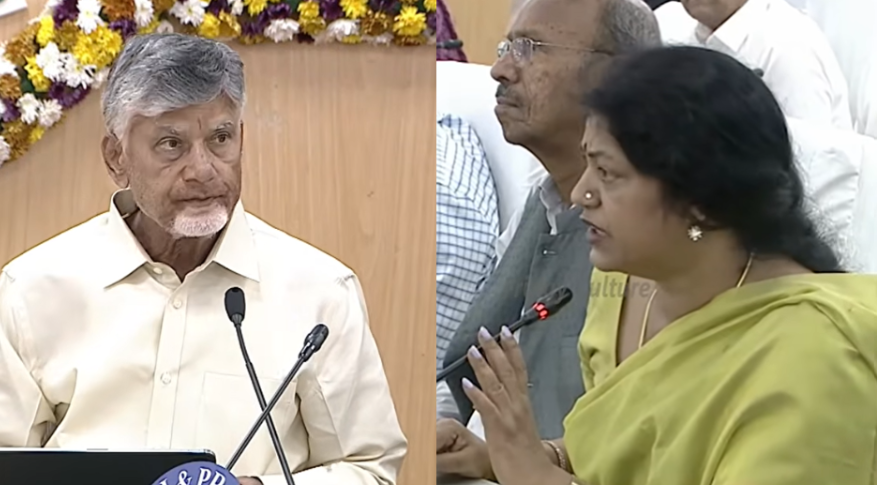
The manner in which Andhra Pradesh Chief Minister Nara Chandrababu Naidu interacted with senior IAS officer K. Sunitha during the Collectors’ Conference has become a topic of political and administrative discussion.
A video showing Sunitha attempting to explain the differences between Central Government guidelines on EWS rules and online verification and the corresponding State Government regulations has triggered debate. In the video, Chandrababu appears to interrupt her several times while she is explaining the issue.
This has raised questions over whether it was appropriate for the Chief Minister to intervene repeatedly instead of allowing a senior officer to complete her explanation.
Senior IAS Officer With Extensive Administrative Experience
K. Sunitha has served in several key departments and is known for her experience in administration and her understanding of government rules and procedures.
Against this backdrop, her earlier role in the Skill Development case during the previous TDP government has once again come under discussion.
Sunitha’s Objections Over Skill Development Funds
During the TDP government, Sunitha served as Finance Secretary. According to references in investigation documents and case records, she had raised objections on the release of the State Government’s share of funds for the Andhra Pradesh State Skill Development Corporation (APSSDC)-Siemens project.
Her reported position was that releasing the government’s share before the Siemens Business Center of Excellence was fully established was contrary to the prescribed procedures.
Records cited in connection with the case also indicate that the project was expected to receive 90 percent of its cost as a grant-in-aid, while the State Government was to contribute the remaining 10 percent.
Questions Over Release of ₹371 Crore
According to the records and arguments referred to in the case, Sunitha had also questioned the decision to release around ₹371 crore, described as the State Government’s 10 percent share, before the expected 90 percent grant-in-aid was received.
Her reported objections were subsequently noted in the relevant file proceedings. The case records have referred to the allegation that the funds were ultimately released despite her reservations, following directions from higher authorities in the government.
CID and ED Investigations
The utilisation and release of funds connected with the Skill Development project subsequently became the subject of investigations by the Andhra Pradesh CID and the Enforcement Directorate (ED).
The developments surrounding the case eventually formed part of the broader legal proceedings that led to the arrest of Chandrababu Naidu in the Skill Development case.
Debate Over the Collectors’ Conference Incident
It is against this background that the recent interaction between Chandrababu and Sunitha at the Collectors’ Conference has attracted renewed attention.
When a senior IAS officer with experience in finance and administration is explaining a procedural or policy-related issue, questions are being raised over whether the Chief Minister should allow the officer to present the complete explanation before intervening.
Should Officers’ Views Be Given Full Consideration?
Many believe that elected governments and senior officials have different but complementary roles in administration. While the Chief Minister has the authority to seek clarifications and question officials, officers’ explanations regarding rules, procedures and government guidelines are also an important part of informed decision-making.
The latest video has therefore triggered a broader debate: When a senior officer is explaining a matter involving government rules and procedures, should the Chief Minister not hear the complete explanation before intervening?
Criticism Over Chandrababu’s Approach
Critics argue that repeatedly interrupting an officer during an official meeting such as the Collectors’ Conference could create the impression that the administration is being driven by the view that the political leadership already has all the answers.
Supporters of the government, however, could view such interventions as part of the Chief Minister’s role in seeking immediate clarification and ensuring that officials provide precise explanations.
The incident has nevertheless brought the relationship between political leadership and the permanent administrative machinery back into focus, particularly over the importance of allowing senior officials to explain rules and procedures before final decisions are taken.