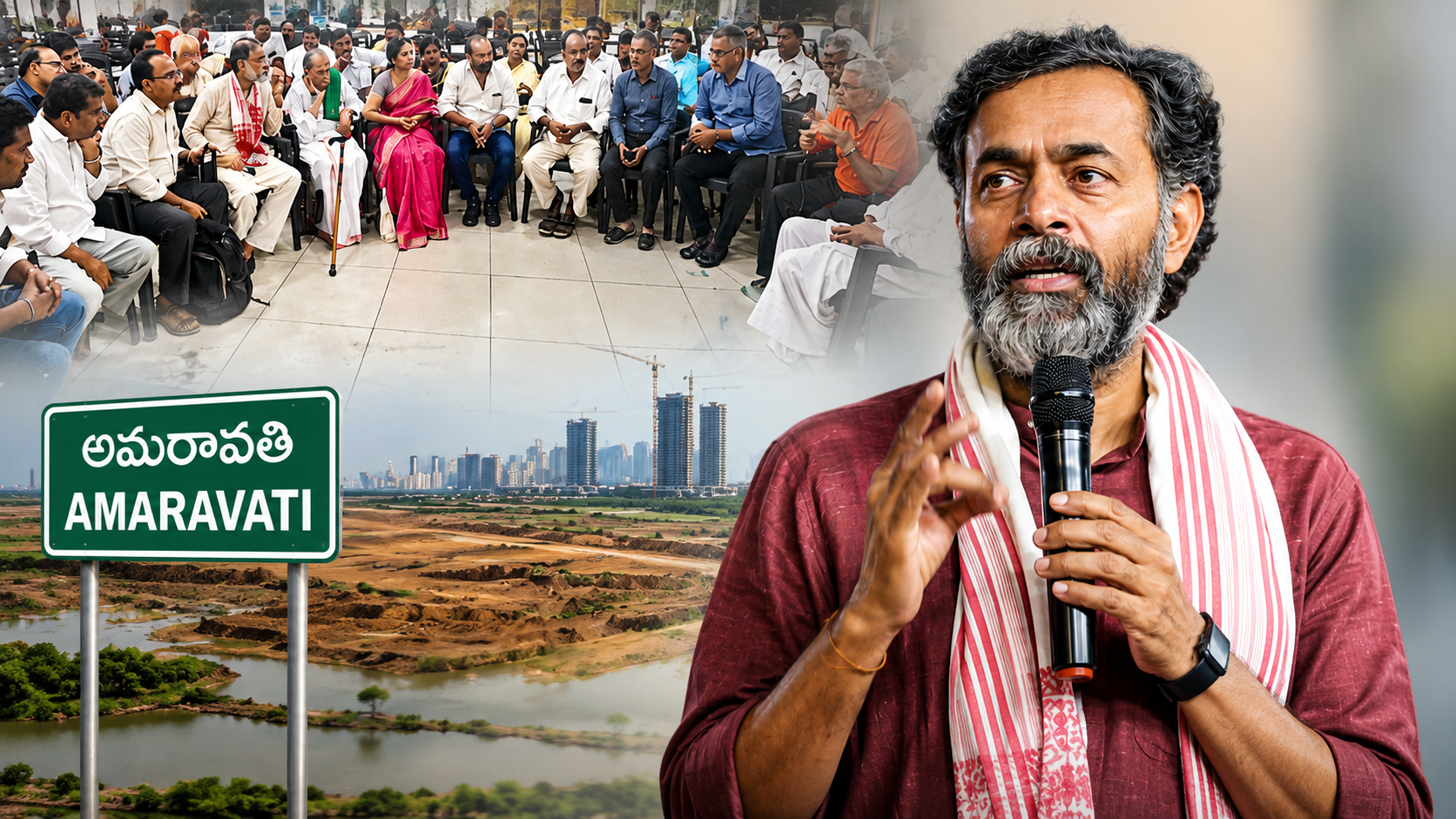
The issue of land in the Amaravati capital region has once again triggered intense political debate. Prominent social activist and professor Yogendra Yadav recently met farmers in the capital region and personally heard about the problems they have been facing. His remarks have once again brought the controversial land issue in Amaravati into the spotlight.
Yogendra Yadav alleged that an “extremely large-scale land grab” was taking place in Amaravati. He said he would raise his voice at the national level so that the allegations surrounding the land issue receive wider attention. He also called on farmers to unite and fight against what they describe as government pressure, assuring them of support and legal assistance.
“I Will Raise the Land Issue at the National Level”
During his meeting with Amaravati farmers, Yogendra Yadav listened to their grievances in detail. The farmers alleged that they had faced pressure from the Chandrababu Naidu government during the land-pooling process. They explained the difficulties they continued to face even after handing over their lands and highlighted the problems they allegedly encountered because of government decisions.
After hearing the farmers, Yadav reacted strongly. He said the Amaravati land issue should not be viewed merely as a local problem and argued that it deserved national-level attention.
He assured the farmers that he would raise the issue nationally and stand by their struggle.
11,000 Acres of Lakes and Ponds in 29 Villages? Farmers Question Government’s 800-Acre Figure
Farmers reportedly told Yogendra Yadav that lakes, ponds and other water bodies across 29 villages in the Amaravati capital region cover nearly 11,000 acres. However, they alleged that the government was showing the area of such water bodies as only around 800 acres.
The alleged difference between the two figures has become a major point of concern among farmers. They are demanding clarity on the actual extent of water bodies, their boundaries and the nature of the lands covered by official records.
The discrepancy has raised several questions: Where did the alleged 11,000 acres of water bodies go? How did the figure of 800 acres emerge? Farmers are demanding that the government make the relevant records public.
Farmers Raise Concerns Over Buffer Zones and Water-Body Lands
Farmers also reportedly brought another major issue to Yadav’s attention concerning land pooling. They alleged that lands falling within buffer zones and water bodies were also being allotted or dealt with as part of the land-pooling process.
According to the farmers, decisions concerning land use in the name of capital development could affect their future and livelihoods. They demanded that the government clearly explain its policy regarding water bodies, buffer zones and lands falling within those areas.
Crop Loans Allegedly Halted After Amaravati Was Declared the Capital
Farmers said their difficulties increased after the region was designated as the capital area. They alleged that banks were not providing them with crop loans, despite agriculture remaining an important source of livelihood.
For farmers dependent on their land for income, the lack of access to agricultural credit can create significant financial pressure. They questioned how they could sustain themselves if restrictions were imposed on their land while financial support based on those same lands was allegedly becoming difficult to obtain.
“Even Building a House Has Become Difficult”
The farmers’ grievances reportedly extend beyond agricultural loans. They told Yadav that they were facing several difficulties even when attempting to construct houses.
They alleged that although they continued to have rights over their lands, restrictions associated with the capital region had made it difficult to use those lands freely. According to them, the uncertainty surrounding land-use regulations has affected their day-to-day lives.
“Farmers Must Fight Together Against the Government’s Approach”
Yogendra Yadav called on farmers to fight collectively rather than individually. He urged them to continue their struggle through democratic means and to stand united in protecting their rights.
He also said the problems faced by Amaravati farmers needed to be communicated to people outside the region. He assured them that he would help take their concerns to the national level and support efforts to secure legal remedies.
“We Will Stand With You and Provide Legal Assistance”
Yadav assured the Amaravati farmers that he would support their struggle and said legal assistance would be provided to help them pursue their grievances through appropriate legal channels.
He emphasized the need to take the farmers’ concerns beyond the capital region and bring the Amaravati land issue into a wider national discussion.
Pressure During Land Pooling: Who Will Answer the Farmers’ Questions?
The issues raised by the farmers point to several concerns surrounding the land-pooling process. They have alleged that pressure was applied during the process and that they continue to face difficulties relating to crop loans, house construction and the use of their lands even after giving land for the capital project.
At the same time, the alleged discrepancy between 11,000 acres of lakes and ponds claimed by farmers and the 800-acre figure they attribute to government records has added another layer to the controversy.
Why is there such a significant difference? What is the actual extent of water bodies in the 29 villages? What is the government’s policy regarding buffer zones and water-body lands? What is the legal and administrative basis for decisions affecting farmers’ lands?
These are questions for which farmers are demanding clear answers from the government.
Amaravati Land Issue Gains Fresh Political Heat
Land-related controversies surrounding Amaravati have repeatedly become a major political issue since the region was designated as the capital.
Yogendra Yadav’s decision to meet farmers directly, listen to their grievances and subsequently describe the alleged developments as an “extremely large-scale land grab” has given the issue renewed political significance.
The episode has once again brought into focus the apparent gap between the government’s development narrative and the concerns being raised by farmers on the ground.
The impact of capital development on farmers’ land, water resources and livelihoods remains a matter that requires greater public scrutiny and transparency.
Amaravati Land Records Must Be Made Public
The Amaravati land controversy can no longer be viewed simply as an issue concerning a section of farmers. Allegations of land grabbing, claims of pressure during land pooling, the dispute over 11,000 acres versus 800 acres of water bodies, concerns over buffer zones and water-body lands, difficulties in obtaining crop loans, and problems related to house construction have collectively raised serious questions about the government’s policies.
The government should provide a comprehensive response to the allegations raised by farmers and make relevant official records, land details, water-body measurements and buffer-zone information available to the public.
Only complete transparency can clarify the competing claims and establish the actual facts.
Yogendra Yadav’s allegation of an “extremely large-scale land grab” in Amaravati has therefore brought one key question back into focus:
What are the complete facts and figures behind the Amaravati land issue, and when will those details be placed before the public?