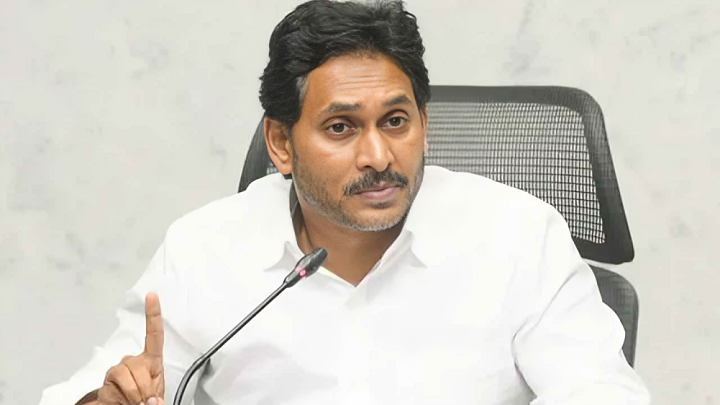
Andhra Pradesh former Chief Minister and YSR Congress Party (YSRCP) president Y.S. Jagan Mohan Reddy has expressed concern over the declining number of students enrolled in government schools across the state. He said official UDISE+ data from the Union Ministry of Education showed a significant fall in government-school enrolment between the 2023–24 and 2025–26 academic years.
Government School Enrolment Declines by Over 5.5 Lakh
According to Jagan, Andhra Pradesh had 4,050,116 students enrolled in government schools during 2023–24. By 2025–26, the number had fallen to 3,493,450.
This represents a decline of 556,666 students in just two academic years. Jagan said the figures raise serious questions about the condition of government education in the state.
He also questioned the coalition government’s claim that more than 1.10 lakh students had shifted from private schools to government schools. According to him, the official central government data presents a different picture.
Number of Government Schools Also Falls
Jagan said the decline was not limited to student enrolment. The number of government schools in Andhra Pradesh also decreased from around 45,000 in 2023–24 to 44,222 in 2025–26.
Similarly, the number of government-aided schools reportedly declined from 991 to 797 during the same period.
In contrast, private schools witnessed an increase in student enrolment. The number of students in private schools rose from 4,553,380 in 2023–24 to 4,840,296 in 2025–26.
Private Schools See Rise in Student Numbers
Jagan pointed out that while student numbers in government and aided schools were declining, private schools were recording an increase.
He said the figures highlighted a gap between the claims being made by the coalition government and the enrolment data reported through official central government statistics.
According to Jagan, the trend requires the state government to examine why students and parents are increasingly moving towards private schools.
Allegations Over Influence of Private Educational Institutions
Jagan also alleged that private educational institutions such as Narayana, Sri Chaitanya, Bhashyam, Vignan and GITAM have a significant influence on the education sector in Andhra Pradesh.
He questioned whether the alleged political and institutional links between some of these educational groups and the TDP were contributing to the weakening of the government education system.
These allegations are part of Jagan’s broader criticism of the coalition government’s education policies.
Poor and Middle-Class Families Could Be Most Affected
The YSRCP chief said the impact of declining government-school enrolment could be particularly severe on poor and middle-class families who cannot afford the cost of private education.
He argued that if government schools fail to provide quality education and adequate infrastructure, economically disadvantaged students could be placed at a significant disadvantage.
Jagan stressed that strengthening government schools is essential to ensure that quality education remains accessible to children from all sections of society.
Jagan Highlights Nadu-Nedu Reforms
Jagan also recalled the education-sector reforms undertaken by his government between 2019 and 2024.
He said the Mana Badi Nadu-Nedu programme was launched to improve infrastructure in government schools, welfare hostels and junior colleges. According to him, infrastructure development initiatives were taken up across 56,703 educational institutions.
The programme included improvements such as furniture, safe drinking water, running-water toilets and additional classrooms.
Infrastructure Development Under Nadu-Nedu
Jagan said work under the first phase of Nadu-Nedu was completed in 15,715 schools, while the second phase was extended to another 22,344 schools.
He claimed that his government spent approximately ₹8,524 crore on the Nadu-Nedu programme to improve educational infrastructure.
According to him, the objective was to transform government schools and provide students with facilities comparable to those available in private and corporate educational institutions.
Free Tablets and Digital Learning
Jagan said his government also introduced technology-based learning initiatives in government schools.
He stated that free tablets containing BYJU’S educational content were distributed to Class 8 students and teachers.
He further said the government introduced digital teaching facilities, including approximately 62,000 interactive flat panels in classrooms from Class 6 onwards.
Around 45,000 smart televisions were also installed in schools with students from Classes 1 to 5, according to Jagan.
Focus on English-Medium Education
Jagan said his government introduced English-medium education from the primary level with the aim of enabling students from poor families to compete at national and international levels.
He said bilingual textbooks and Oxford dictionaries were also provided to students as part of the initiative to improve their language skills.
TOEFL Training for Students
Another major initiative highlighted by Jagan was the introduction of TOEFL training from Class 3 onwards.
He said an agreement was entered into with the US-based Educational Testing Service to provide students with opportunities to pursue international-level TOEFL certification.
The objective, according to Jagan, was to strengthen students’ English-language abilities from an early stage and prepare them for global competition.
Steps Towards International Baccalaureate Education
Jagan also said steps were initiated to introduce the International Baccalaureate (IB) education system in Andhra Pradesh.
He stated that training and capacity-building programmes were undertaken for teachers, headmasters, Mandal Education Officers and other education department personnel as part of preparations for the IB framework.
Jagan Calls for Focus on Government Education
Jagan maintained that his government had taken several steps to modernise government schools and bring them on par with corporate educational institutions.
However, he expressed concern that government-school enrolment has declined significantly while private-school enrolment has increased.
He said the latest enrolment figures should prompt the coalition government to review the situation and take corrective measures to strengthen public education in Andhra Pradesh.
According to Jagan, ensuring quality education through government schools is particularly important for poor and middle-class families who may not have the financial capacity to afford private schooling.