Education: The Foundation of a State’s Future
Education is the most powerful instrument for shaping the future of any state. Governments may change and policies may evolve, but if the education system weakens, its impact is felt for generations. That is why every statistic related to school education serves as an indicator of the direction in which a society is moving.
The latest UDISE+ (Unified District Information System for Education Plus) reports released by India’s Ministry of Education have once again brought Andhra Pradesh’s school education sector under scrutiny. An examination of the data over the last three academic years (2023–24 to 2025–26) raises an important question: Is Andhra Pradesh’s education system progressing, or is it gradually heading toward a crisis?
Declining Student Enrollment Raises Serious Concerns
One of the most worrying trends highlighted in the report is the decline in student enrollment.
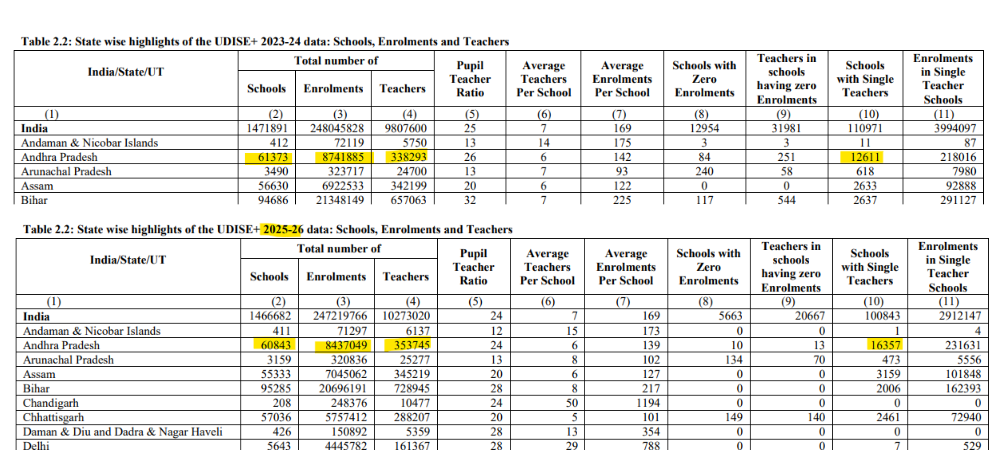
Total school enrollment in Andhra Pradesh fell from 8.742 million (87.42 lakh) in 2023–24 to 8.437 million (84.37 lakh) in 2025–26, reflecting a decline of nearly 300,000 students within just two academic years.
During the same period, the number of schools also decreased from 61,373 to 60,843, indicating that 530 schools were no longer operational.
According to education experts, these figures may suggest a gradual decline in public confidence in government schools.
Criticism Over the Reasons Behind Falling Enrollment
Critics attribute the decline in student enrollment to what they describe as the ineffective functioning of the School Education Department under Education Minister Nara Lokesh.
They argue that delays in implementing student welfare schemes, reductions in certain benefits, late distribution of educational kits, concerns over the quality of the Mid-Day Meal Scheme, and reported food poisoning incidents in some schools have created anxiety among parents.
According to these critics, such issues may have contributed to parents becoming reluctant to continue sending their children to government schools.
Sharp Rise in Single-Teacher Schools
Another major concern highlighted by the UDISE+ data is the increasing number of single-teacher schools.
The number of such schools rose from 12,611 in 2023–24 to 16,357 in 2025–26.
As a result, more than 200,000 students are reportedly dependent on a single teacher for their education, raising questions about the quality of classroom instruction, individual attention, and overall learning outcomes.
Infrastructure Development Appears to Have Slowed
The condition of school infrastructure also presents a mixed and concerning picture.
Thousands of schools continue to lack digital libraries, and critics point out that their number has declined compared to previous years. Basic facilities such as separate toilets for boys and girls are still unavailable in all schools.
The number of schools equipped with solar panels has also reportedly decreased, leading to allegations of inadequate maintenance and reduced focus on infrastructure.
Opposition voices argue that the discontinuation of the earlier “Nadu-Nedu” school infrastructure development programme has slowed the pace of improvement in government schools.
Government Schools Are More Than Educational Institutions
Government schools are not merely places of learning; they are the foundation of social equality.
For millions of economically weaker families who cannot afford private education, government schools remain the primary avenue for quality education and upward mobility.
If this system weakens, the greatest burden is likely to fall on society’s most vulnerable sections.
The Need for Immediate Corrective Measures
The UDISE+ statistics serve as a warning not only for the government but for society as a whole.
A state that falls behind in education risks falling behind in overall development. Experts therefore emphasize the urgent need to:
- Fill teacher vacancies without delay.
- Strengthen school infrastructure.
- Improve implementation of student welfare schemes.
- Restore public confidence in government schools.
- Ensure better quality monitoring of education and nutrition programmes.
The Road Ahead
Investment in education is ultimately an investment in the future.
The decisions taken today will determine the opportunities available to the next generation. Whether the Andhra Pradesh government treats these UDISE+ findings as a call for meaningful educational reforms or chooses to overlook the warning signs remains one of the most significant questions facing the state’s education sector.
The answer will shape not only the future of government schools but also the future of millions of children across Andhra Pradesh.