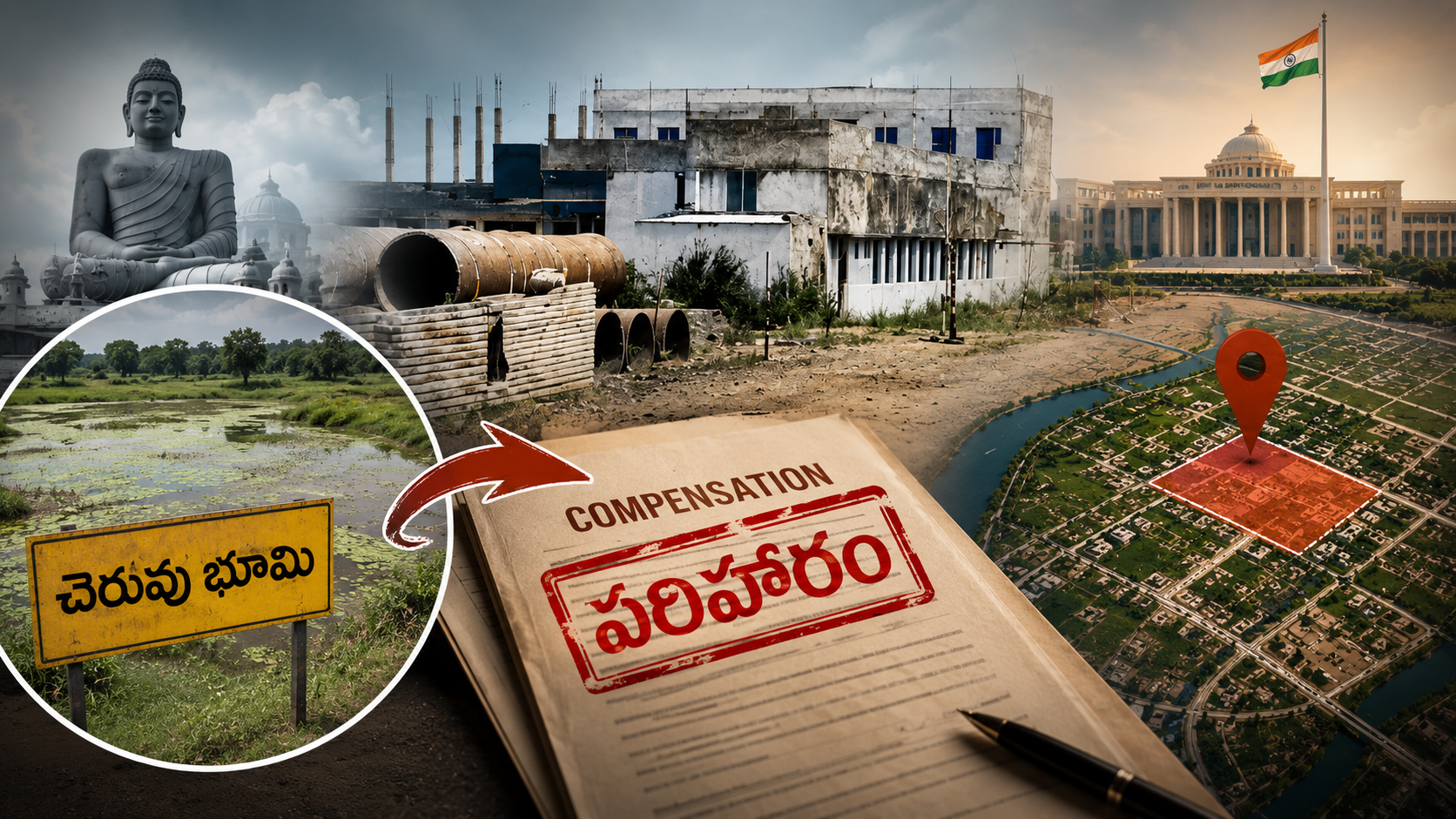
Fresh allegations have surfaced over the Amaravati land pooling process, with claims that a private educational institution constructed on encroached lake land in Thulluru village not only received government compensation but was also allotted residential and commercial plots. Documents cited in the allegations further claim that the beneficiaries later secured an additional three acres of valuable land using allegedly forged certificates.
The issue has triggered widespread debate, with critics alleging a massive loss to the state exchequer. Farmers and legal experts are demanding a comprehensive and independent investigation into the matter.
Compensation for Encroached Lake Land Raises Questions
According to revenue records of Thulluru village in the Amaravati Capital Region, nearly 60 cents of government lake land was allegedly encroached upon and a private college was constructed on it. Local reports claim that the institution is managed by leaders associated with the Telugu Desam Party (TDP).
Legal experts point out that lake land is classified as government property, and structures built on such land are generally not eligible for compensation under the law. However, allegations suggest that the same land was included in the land pooling process for the construction of the N-14 road, following which the government reportedly paid compensation for the buildings.
This has become the central point of the controversy.
Three Benefits from a Single Property?
One of the most controversial aspects of the case is the allegation that multiple benefits were granted for the same encroached property.
According to documents cited in the allegations, the beneficiaries received:
- A 2,909-square-yard residential plot
- A 500-square-yard commercial plot
- ₹1.40 crore as compensation for the college buildings
The records reportedly mention that these benefits were allotted to Gadde Mangaiah, President of the Thulluru Educational Society.
The key questions being raised are:
- How was compensation paid for buildings allegedly constructed on government land?
- Under which legal provisions were land pooling benefits extended to such a property?
Allegations of Forged Certificate to Secure More Land
The controversy does not end there.
According to the allegations, a forged ownership certificate was allegedly created claiming ownership of 3.10 acres adjacent to the college premises.
Based on this document, the beneficiaries reportedly approached the Capital Region Development Authority (CRDA), seeking an alternative land allotment.
Questions are now being raised over whether the CRDA properly verified the ownership records and land documents before processing the application.
Three Acres Near Secretariat After Union Minister’s Recommendation?
Documents referred to in the allegations claim that the situation changed significantly after the intervention of a Union Minister.
Subsequently, nearly three acres of highly valuable land were allegedly allotted near the proposed permanent Secretariat in Amaravati as an alternative.
Considering the enormous market value of land in the capital region, the allotment has drawn sharp criticism, with observers alleging that public assets were transferred at a huge cost to the government.
Were Supreme Court Guidelines Ignored?
The Supreme Court has repeatedly issued guidelines regarding the protection of lakes and public water bodies.
The principles generally emphasize that:
- Lakes and water bodies should not be encroached upon.
- Illegal occupants should not be granted legal ownership rights.
- Unauthorized constructions on government land should not be encouraged.
Critics argue that if the allegations are true, granting compensation and additional land to an alleged encroacher would be contrary to these principles.
Farmers Express Anger, Local Leaders Reportedly Surprised
The issue has reportedly caused concern even among some local TDP leaders.
Farmers who voluntarily contributed land for the Amaravati capital project say they are still awaiting justice on several pending issues. Against that backdrop, allegations that an institution built on encroached lake land received compensation, developed plots, and alternative land have fueled resentment.
Many residents are now asking:
“Is there one rule for farmers who gave up their land and another for alleged encroachers?”
Investigation May Reveal More Facts
Legal experts believe that an independent investigation could clarify several critical questions, including:
- How was the lake land allegedly encroached?
- How was the land included in the land pooling process?
- Under what rules was ₹1.40 crore in compensation sanctioned?
- How were the 2,909-square-yard residential and 500-square-yard commercial plots allotted?
- Was the certificate relating to the 3.10 acres genuine or forged?
- How was approval granted for the alternative three-acre allotment?
Demand for Independent Probe Grows
The Amaravati land pooling process has witnessed several controversies over the years, and the Thulluru lake land issue has added another serious chapter to the debate.
If the allegations regarding compensation, plot allotments, and the allocation of valuable alternative land are established through investigation, critics argue that the case could amount to a major land scam involving significant loss to the public exchequer.
Farmer associations, legal experts, and civil society groups are demanding a transparent and independent inquiry to determine the facts and, if any irregularities are proven, to ensure appropriate legal action against those responsible.