Temple lands and properties are not ordinary government assets. They represent the faith, devotion and sacrifices of millions of devotees who donated them over centuries with the belief that they would serve religious institutions for generations to come.
Yet today, vast stretches of these sacred assets appear to be slipping through the cracks of an increasingly ineffective system, raising troubling questions about whether the Andhra Pradesh government is doing enough to protect what rightfully belongs to temples and devotees.
A Crisis Hidden in Plain Sight
The Andhra Pradesh Endowments Department oversees thousands of acres of temple land and numerous valuable properties donated by kings, philanthropists and devotees over hundreds of years.
These properties were intended to generate revenue for temple maintenance, religious activities, charitable initiatives and the welfare of devotees.
Instead, a significant portion of these assets has become entangled in legal disputes, encroachments and administrative neglect.
Despite repeated assurances about safeguarding temple properties, critics argue that the government has shown little urgency in addressing the growing crisis.
Tribunal Headless for 18 Months
At the centre of this administrative paralysis is the Endowments Tribunal—the institution specifically established to resolve disputes relating to temple properties.
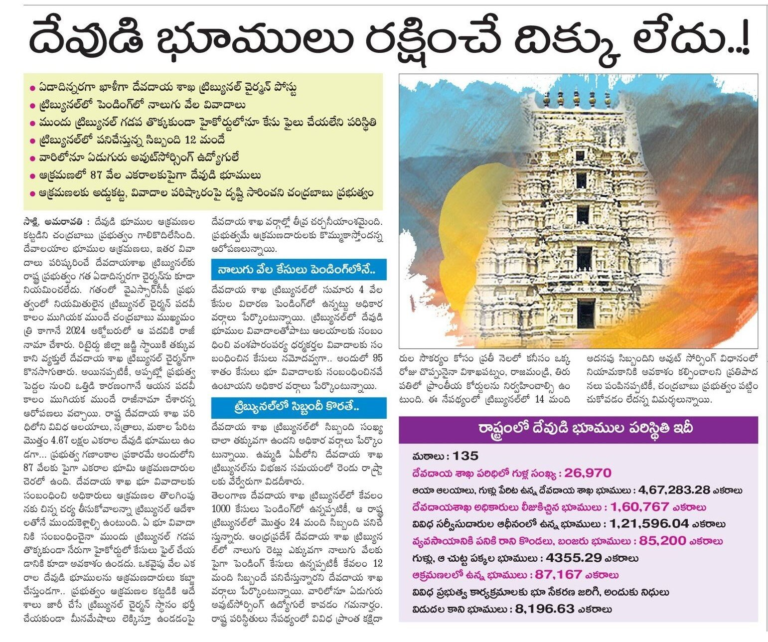
Shockingly, the post of Tribunal Chairman has remained vacant for nearly 18 months.
Without leadership, the very body entrusted with protecting temple assets has been reduced to a dysfunctional institution struggling to discharge its responsibilities.
The prolonged vacancy has prompted serious concerns about the government’s commitment to preserving temple wealth. If protecting temple properties was truly a priority, why has such a critical position remained unfilled for a year and a half?
More Than 4,000 Cases Left in Limbo
The consequences of this neglect are staggering.
More than 4,000 cases involving temple properties are reportedly pending before the Tribunal. These include disputes related to ownership, illegal occupation, lease violations and revenue recovery.
For temples awaiting justice, the delay is not merely procedural—it is costly.
Every postponed hearing potentially strengthens the position of encroachers while weakening the ability of religious institutions to reclaim their assets.
Justice delayed, in this context, risks becoming justice denied.
Temples Have Nowhere Else to Turn
The legal framework itself has compounded the crisis.
Under existing provisions, disputes relating to temple properties must first pass through the Endowments Tribunal. In many cases, parties cannot directly approach the High Court without exhausting the Tribunal process.
But when the Tribunal itself is crippled by vacancies and inaction, a troubling question emerges:
Where are temples expected to seek justice?
A system designed to protect religious institutions has instead become a bottleneck preventing timely resolution.
Twelve Employees to Protect a Massive Religious Legacy
The scale of the mismatch between responsibility and resources is difficult to ignore.
The Tribunal, tasked with overseeing disputes involving thousands of crores worth of temple assets across Andhra Pradesh, reportedly functions with only 12 employees.
Even more concerning, seven of them are temporary staff members.
Expecting such a skeletal workforce to safeguard one of the state’s largest repositories of religious wealth raises serious questions about administrative priorities.
Critics argue that this is not merely understaffing—it reflects a broader failure to recognise the urgency of protecting temple assets.
Over 87,000 Acres Under Encroachment
Perhaps the most alarming figure is the extent of alleged encroachment.
Government records themselves indicate that more than 87,000 acres of temple land are under unauthorised occupation.
This is not just land.
These properties represent the economic backbone of countless temples. Revenue generated from them supports daily rituals, employee salaries, festivals, maintenance, charitable activities and community services.
Every acre lost to encroachment directly impacts institutions sustained by the faith of millions.
Yet despite the enormity of the problem, there appears to be no visible statewide campaign, special drive or comprehensive strategy to recover these assets.
Promises Without Action?
The government has repeatedly spoken about protecting temple properties and preserving religious institutions.
However, critics point out that the reality tells a different story.
- The Tribunal Chairman’s post remains vacant.
- More than 4,000 cases continue to pile up.
- Staffing shortages remain unaddressed.
- Encroachments persist on an alarming scale.
- No major recovery initiative has been announced.
- No clear roadmap has been presented to resolve the crisis.
For many devotees, the gap between official assurances and administrative action is becoming increasingly difficult to ignore.
Beyond Politics: A Question of Trust
Temple properties do not belong to any political party or government of the day.
They belong to the deities, the institutions they sustain and the millions of devotees who contributed to them with faith and devotion.
Protecting these assets is not merely an administrative duty; it is a sacred responsibility.
When institutions created to defend temple interests remain leaderless, when thousands of disputes languish unresolved, and when tens of thousands of acres continue under encroachment, concerns over government inefficiency inevitably intensify.
The question now confronting the Andhra Pradesh government is straightforward:
If it cannot protect the properties entrusted to it by generations of devotees, how can it claim to be safeguarding the trust of those very devotees?
Until decisive action replaces prolonged inaction, the demand for accountability is only likely to grow louder.